Global remote hiring is not just a bigger version of traditional hiring. It requires a different way to find, vet, and trust talent.
Hiring has changed. The platforms many companies still rely on have not.
That does not mean we are living in a fully remote-first economy. In fact, remote jobs can feel harder to find in some parts of the market. But at the same time, remote work, contract work, and global hiring are becoming more common. The definition of a job is changing, and companies are becoming more open to hiring talent beyond their immediate geography.
That shift creates a new problem. Traditional recruitment sites were built for an older hiring model. They were not designed for the realities of modern global remote hiring, where employers need to evaluate communication, identity, trust, and authenticity before making a hiring decision.
That gap is the problem Remote Recruit was built to address.
Hiring Has Changed, but the Platforms Have Not
The original problem was simple. The existing recruitment channels did not have the technology needed to source and screen remote candidates at scale.
For employers hiring locally, the recruitment process is already difficult enough. But when a role opens up to a global talent pool, the challenge becomes much bigger. Employers are no longer just reviewing resumes from one city or one region. They are evaluating candidates from around the world, often across time zones, cultures, and languages.
That requires a completely different approach.
It is not just about listing a remote job and waiting for applicants. It is about finding better ways to screen people, verify who they are, understand how they communicate, and assess whether they are truly capable of doing the work they say they can do.
Traditional recruitment sites were not built for that.
Global Remote Hiring Is Harder Than Traditional Hiring
Hiring remotely inside one country is difficult. Hiring globally is even harder.
When a company hires for a global remote role, the candidate pool becomes much larger, but so do the risks and the complexity. Employers need to quickly evaluate whether candidates can communicate in the preferred language, whether their experience is real, and whether they can operate effectively in a remote environment.
That is a very different challenge from hiring within a single local market.
Global remote hiring requires employers to answer questions like:
- Is this person really who they say they are?
- Do they actually have the skills listed on their profile?
- Can they communicate clearly in the language the role requires?
- Can they work professionally in a fully remote environment?
- Does their work history reflect real experience?
These are not minor questions. They are central to making a good hiring decision.
Traditional recruitment sites often stop at the application stage. But in modern global hiring, the real challenge begins after the application comes in.
The Old Recruitment Stack Is Fragmented
Another problem is that the hiring process is often spread across too many tools.
A company may use one platform to post jobs, another to source candidates, another for video screening, and another for applicant tracking or HR workflows. That creates a fragmented hiring stack that forces recruitment teams to piece together the process on their own.
This makes modern remote hiring more complicated than it needs to be.
Instead of having one system that supports candidate discovery, screening, and evaluation for global remote hiring, many employers are forced to build their process across disconnected technologies. That slows teams down and makes it harder to create a consistent candidate experience.
Remote Recruit was created in response to that problem. The tools and technology needed for remote hiring did not exist in one place, so the process remained scattered and inefficient.
New Recruitment Threats Require New Screening Methods
Modern remote hiring also faces threats that traditional recruitment sites were never designed to handle well.
When hiring globally and remotely, employers have a much higher likelihood of dealing with identity issues, skill exaggeration, and candidates who are not exactly who they claim to be. A person can perform well enough in an early interaction and still turn out to be a poor fit, or worse, someone entirely different from the individual the employer believed they were hiring.
That is why remote hiring requires different ways of vetting and screening candidates.
The goal is no longer just to collect applications. The goal is to distinguish fact from fiction earlier in the hiring process.
Employers need to know that the person they are speaking with is real, that their background is legitimate, and that their capabilities match what they claim. In a global remote market, this matters more than ever.
Traditional recruitment sites, built around profiles and resumes alone, do not solve that problem well.
Why PDF Resumes Are No Longer Enough
For years, the resume was treated as the foundation of candidate evaluation. But for remote global hiring, a PDF resume is simply not enough.
A resume can list experience, but it cannot confirm identity. It can describe communication skills, but it cannot show how someone actually communicates. It can make a candidate look polished, but it cannot prove authenticity, professionalism, or real ability.
This becomes even more important in remote hiring, where employers often do not have the same level of in-person visibility they might have in a traditional office-based process.
In other words, a resume may still have a place, but it should not be the only layer of evaluation.
Modern global remote hiring needs stronger screening methods that go beyond static documents.
Closed Systems Are Part of the Old Model
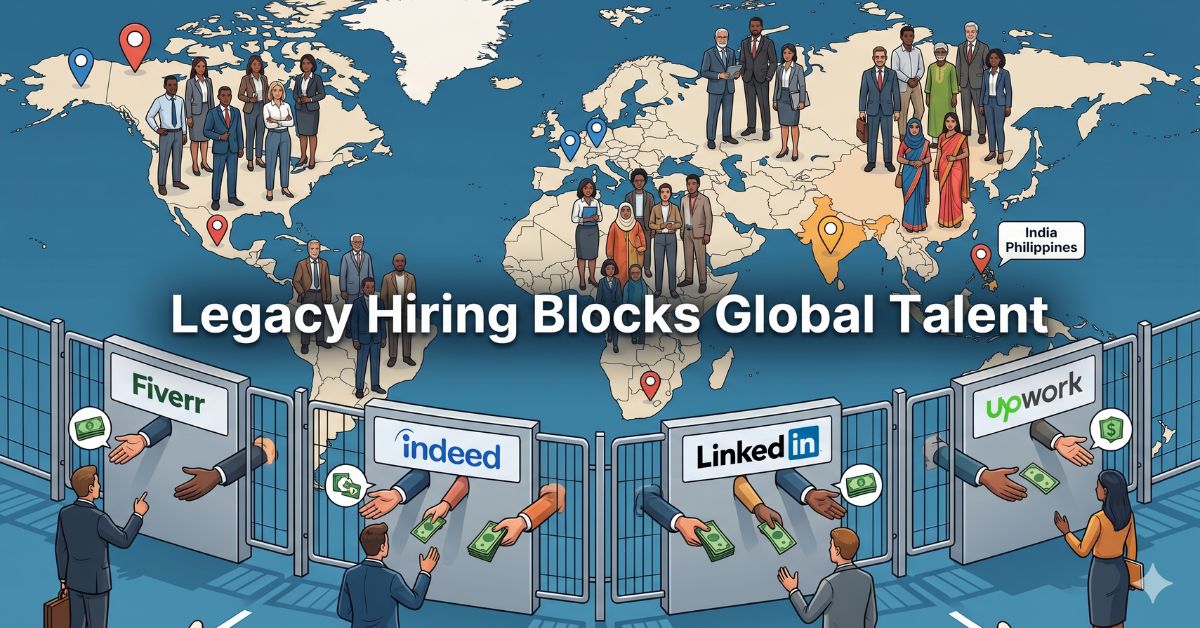
Platforms like Upwork and Fiverr highlight an important issue with closed hiring systems.
These platforms are examples of closed systems. Their ecosystem is built to keep the discovery, communication, hiring, and payment process inside the same environment. That may work for a certain model of freelancing, but it creates limitations for employers who want more flexibility.
If an employer finds a candidate they like, it can be difficult to move that relationship outside the platform. Communication can be restricted. Long-term hiring flexibility can be reduced. The whole model is designed to keep employers and talent inside the platform.
That is part of what makes these systems feel outdated for modern global hiring.
Remote Recruit is challenging that model by taking a more open approach. Instead of creating another paywalled or tightly controlled system, the goal is to make global hiring more accessible and less restrictive.
That is a major difference.
The Overemphasis on Geography Is Holding Hiring Back
Traditional hiring models often place too much emphasis on geography.
For years, companies limited themselves to specific regions, cities, or hiring markets. But global hiring opens up access to a much broader range of talent. It allows employers to look beyond traditional talent pools and connect with candidates who may be a strong fit, even if they live outside the company’s usual sourcing geography.
This has two major implications.
First, companies can unlock more talent than they would by hiring only in familiar local markets.
Second, they may reduce human capital costs by hiring in markets where payroll expectations are different from the traditional hiring centers they have relied on in the past.
The more companies open themselves to global hiring, the more likely they are to find qualified talent they may have otherwise overlooked.
That is one of the biggest reasons the old model is breaking down. It was built around limited geography, not open global access.
Remote Recruit Represents a More Open Hiring Model
Remote Recruit should not be viewed as just another job board.
It was built because the tools for remote global hiring did not exist in the way employers needed them to. The challenge was never just about finding candidates. It was about bringing together the concepts and technologies that modern remote hiring requires.
That includes:
- better access to global talent
- better ways to vet remote candidates
- better ways to screen authenticity and communication
- a more open approach to employer-candidate relationships
- a more practical model for remote-first and global-first hiring challenges
Remote Recruit is positioned as a more modern alternative to traditional recruitment sites and closed hiring platforms because it is built around the realities of today’s hiring environment, not yesterday’s.
Conclusion
Traditional legacy recruitment sites do not work in the new remote world because the hiring world has changed faster than the platforms supporting it.
Remote and contract work are becoming more common. Global hiring is expanding. Employers now need to evaluate trust, identity, communication, and authenticity at a much deeper level than traditional recruitment systems were designed to support.
They also need a hiring process that is less fragmented, less geography-restricted, and less dependent on closed ecosystems.
That is the opportunity Remote Recruit is built for.
Global remote hiring is not simply the old hiring model done online. It is a different challenge, and it requires a different kind of platform.
Build a Better Global Hiring Process
Traditional recruitment sites were not built for the realities of global remote hiring. Remote Recruit helps employers discover talent, improve candidate screening, and approach remote hiring with a more modern, open model.
Explore Remote Recruit and see how global remote hiring can work better.