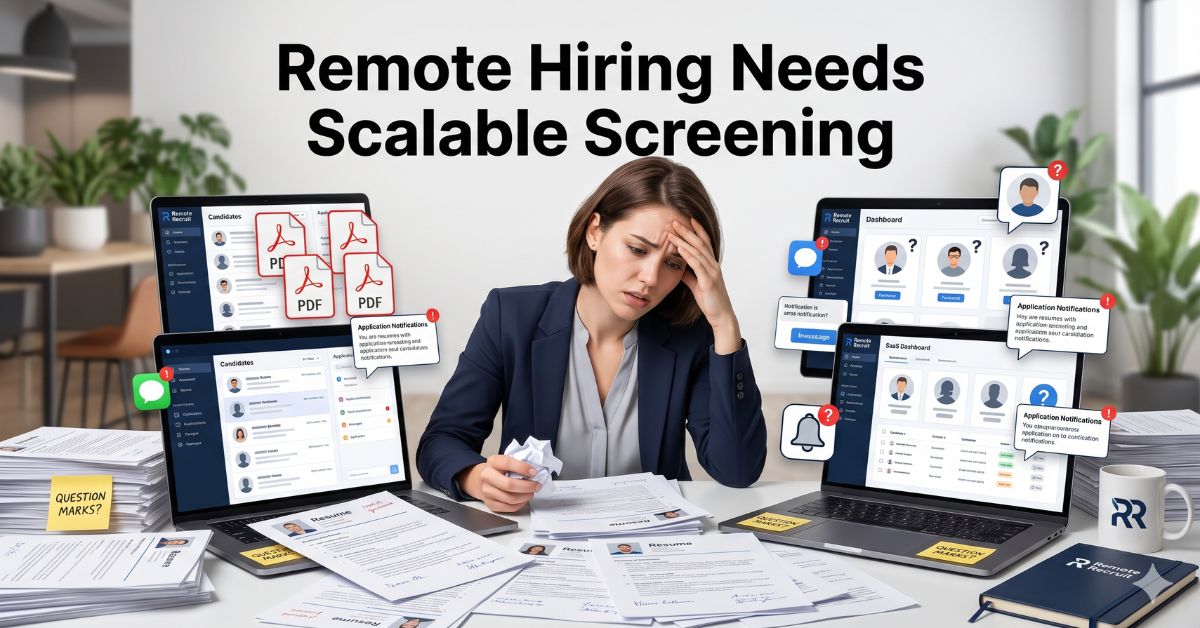
Remote hiring cannot be treated like a one-time task. Employers need a continuous pipeline, scalable screening, and better ways to evaluate candidates before they move deeper into the process.
Remote hiring should not be treated as a one-time event.
Too many companies approach remote hiring the same way they approach traditional hiring. They open a role, collect resumes, interview a few candidates, make a hire, and then stop recruiting until the next urgent need appears.
That model is not built for scale.
A scalable remote hiring strategy requires a different mindset. Employers need to think continuously, not occasionally. They need to build candidate pipelines before roles become urgent. They need screening systems that can handle high applicant volume. They also need better ways to evaluate communication, work ethic, skills, and fit before moving candidates too far into the process.
Remote hiring can create more opportunity, but it also creates more complexity. Employers that want to hire remote talent successfully in 2026 need a process that is built for that reality.
Remote Hiring Should Not Be Treated as a One-Time Event
Traditional hiring often works like a campaign. A company has an opening, posts the job, collects applications, screens candidates, and fills the role.
Remote hiring should not work that way.
When companies hire remotely, especially across larger talent pools, the hiring process needs to be more continuous. Employers should always be building visibility into qualified candidates, even when they are not ready to make an immediate hire.
This does not mean hiring people constantly. It means always keeping the pipeline alive.
A company may not need a candidate today, but it may need one next month. If the company only starts recruiting when the need becomes urgent, it will always be behind. A stronger strategy is to keep sourcing, keep screening, and keep a group of qualified candidates available for future roles.
That is the foundation of scalable remote hiring.
Always Be Recruiting
One of the most important parts of a scalable remote hiring strategy is continuous recruitment.
Employers should not recruit for one position, hire one person, and then stop. Remote roles can change quickly. Team needs shift. Some candidates may not work out. New roles may open faster than expected.
That is why employers need an ongoing system for finding and staying connected with talent.
A continuous recruiting approach helps companies:
- maintain a pool of qualified candidates
- reduce pressure when a role becomes urgent
- move faster when hiring needs appear
- avoid starting from zero every time
- build familiarity with candidates before making decisions
This is especially important for remote hiring because the candidate pool can be much larger. If a role is open to people across countries or regions, employers may receive far more interest than they would for a local position.
Without a continuous process, that volume becomes difficult to manage.
Build a Candidate Pipeline You Can Return To
A strong remote hiring strategy depends on having a pipeline of candidates that employers can return to when needed.
This means companies should not think of every candidate interaction as a pass-or-hire decision. Some candidates may not be the right fit today, but they may be useful later. Others may need more time, more experience, or a different role.
A scalable process should allow employers to stay in touch with qualified candidates and revisit them when the timing is right.
That requires more than posting jobs. It requires systems for keeping jobs active, keeping candidate information organized, and maintaining a steady flow of potential hires.
For remote hiring, this matters because companies may need to move quickly when the right need appears. If there is already a pipeline in place, hiring becomes easier. If there is no pipeline, the employer has to start from the beginning every time.
That is not scalable.
Prepare for Remote Hiring Churn
Remote hiring also requires employers to prepare for the reality that not every hire will work out.
Remote roles can sometimes come with higher churn than in-office roles. That does not mean remote workers are less valuable. It means the hiring process needs to be built to evaluate fit, discipline, communication, and work ethic earlier.
When people work remotely, employers may have less day-to-day visibility into how they operate. Candidates need to be able to stay focused, communicate clearly, manage their time, and prove they can perform without constant supervision.
If those qualities are not evaluated early, the risk of a poor fit increases.
That is why scalable remote hiring is not just about finding more candidates. It is about finding better ways to understand which candidates are likely to succeed in a remote environment.
Use Trial Work Before Full-Time Commitments
For many remote roles, employers should consider using part-time contracts, trial work, or test projects before moving someone into a full-time position.
This approach gives both sides a better way to evaluate fit.
A resume can say someone has experience. An interview can show how they answer questions. But actual work reveals whether the candidate can deliver, communicate, meet expectations, and stay consistent.
Trial-based hiring can help employers understand:
- whether the candidate can complete real work
- whether they communicate clearly
- whether they respond on time
- whether they can follow instructions
- whether they take ownership
- whether they can work independently
This does not mean every role must begin as a trial. But for remote hiring, especially when hiring globally, a gradual hiring path can reduce risk and help employers make more confident decisions.
It gives candidates a chance to prove themselves before the company makes a bigger commitment.
Screening Must Scale With Applicant Volume
One of the biggest challenges in remote hiring is volume.
When a role is remote, especially if it is open to global candidates, the number of applicants can increase quickly. Employers may receive hundreds or even thousands of applications.
That creates a serious screening problem.
Many hiring teams are still built around older processes. They review PDF resumes, read written answers, compare profiles, and manually decide who should move forward. That process may work for a small applicant pool, but it does not scale well when candidate volume increases.
If employers want to build a scalable remote hiring strategy, screening has to become more efficient.
They need a process that helps them cut through the noise earlier. They need better ways to evaluate skills, communication, professionalism, and fit before spending too much time on deeper interviews.
Otherwise, remote hiring becomes overwhelming.
Hiring More Recruiters Will Not Fix an Outdated Process
When candidate volume increases, many HR teams assume the answer is to hire more people to review applications.
But adding more recruiters does not solve the problem if the process itself is outdated.
If the hiring process is still built around reviewing static resumes and written answers, more people will only make the same process bigger. It will not necessarily make it better.
The real issue is not just capacity. It is the screening model.
Remote hiring requires a process that can handle scale without losing quality. Employers need systems that help them identify stronger candidates earlier, instead of forcing recruiters to manually dig through large volumes of applications.
A better process is more valuable than a larger team using the same old method.
Start Video Earlier in the Screening Process
Video is one of the most important tools for scalable remote hiring.
Some hiring teams already use video, but they often bring it in too late. By the time a candidate gets to a video stage, the employer may have already spent significant time reviewing resumes, written answers, and profiles.
Remote Recruit’s model is different because it starts with video.
That matters because video gives employers a stronger signal earlier in the process. It allows them to evaluate how a candidate communicates, how they present themselves, and whether they can speak clearly about their experience before moving them deeper into the hiring funnel.
In remote hiring, communication is not a small detail. It is central to performance.
Video-based screening can help employers understand whether a candidate is confident, professional, and capable of explaining their skills in a way that matches the role.
This helps employers reduce noise and make better decisions earlier.
How Remote Recruit Supports Scalable Remote Hiring
Remote Recruit is built around the idea that remote hiring needs a better process.
It should not be viewed as just another place to post jobs. Its value is in helping employers approach remote candidate evaluation differently.
With video-based candidate profiles, Remote Recruit helps employers move beyond static resumes and written answers. It gives hiring teams an earlier way to assess communication, professionalism, and experience before investing time in deeper interviews.
For employers building a scalable remote hiring strategy, this matters because the process must work even when candidate volume is high.
Remote Recruit helps employers:
- evaluate candidates earlier
- reduce dependence on resume-only screening
- support a more continuous hiring pipeline
- improve visibility into remote candidate communication
- cut through large applicant pools more efficiently
In a remote hiring environment, employers need more than applications. They need a better way to understand the people behind those applications.
That is where video-first screening becomes valuable.
Conclusion
A scalable remote hiring strategy is not built by posting a job and waiting for the right person to appear.
It requires continuous recruiting, active candidate pipelines, smarter screening, and a willingness to evaluate candidates before making long-term commitments. It also requires employers to move beyond old processes that depend too heavily on resumes, written answers, and late-stage interviews.
Remote hiring can create access to a much larger talent pool, but that only works if the screening process can handle the volume.
In 2026, employers need to build remote hiring systems that are always active, flexible enough to test candidates, and strong enough to evaluate communication and fit earlier.
The future of scalable remote hiring depends on pipeline, process, and earlier candidate evaluation.
Build a Remote Hiring Process That Can Scale
Remote hiring becomes harder when employers rely only on resumes, manual screening, and one-time hiring campaigns. Remote Recruit helps hiring teams evaluate candidates earlier with video-based profiles designed for modern remote hiring.
Use Remote Recruit to build a stronger, more scalable remote hiring pipeline.