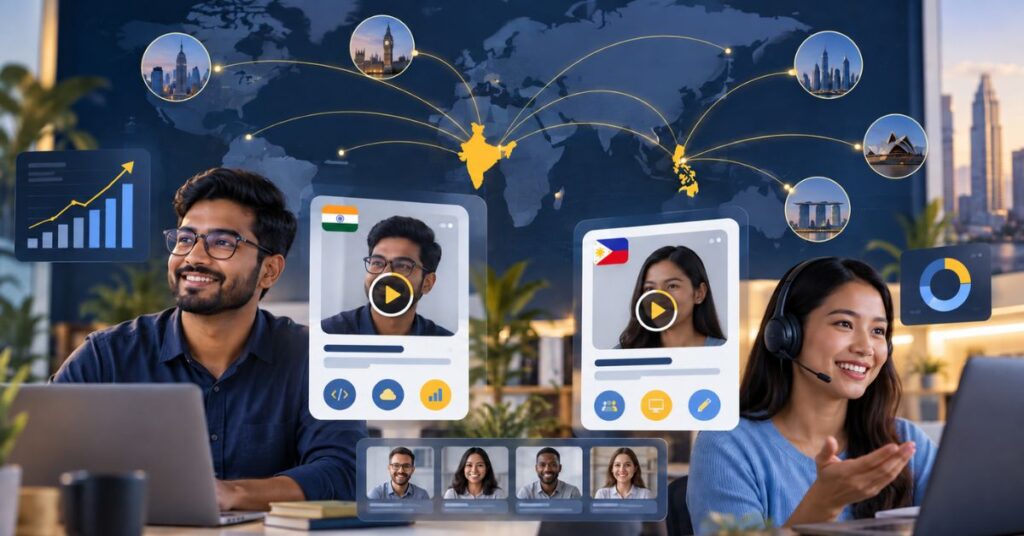
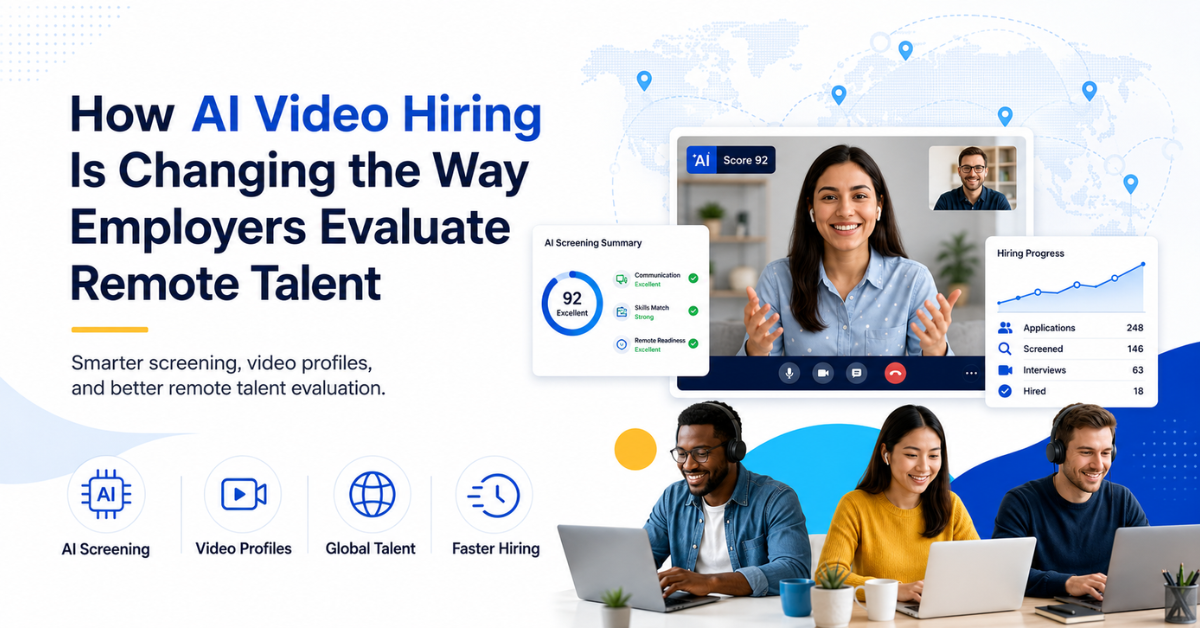
AI Video Hiring is helping employers evaluate remote talent with more speed, structure, and confidence by combining video profiles, AI screening, and smarter hiring insights.
Remote hiring has changed how employers find and assess talent. Companies are no longer limited to candidates who live near the office, which means they can now access skilled professionals across countries, time zones, and industries. This creates a major advantage for employers, but it also creates a new challenge. How can hiring teams confidently evaluate communication skills, professionalism, motivation, and remote work readiness before spending time on interviews?
AI Video Hiring is becoming an important solution to this challenge. It allows employers to go beyond traditional resumes and review candidates through structured video profiles, AI candidate screening, and role-based evaluation signals. Instead of depending only on written applications, hiring teams can see how candidates present themselves, explain their experience, and communicate in a remote-first environment.
This is especially important because remote work requires more than technical ability. Employers need candidates who can communicate clearly, manage tasks independently, collaborate online, and stay accountable without constant supervision. According to SHRM, 43% of organizations used AI in HR tasks in 2025, up from 26% in 2024, showing how quickly AI is becoming part of modern hiring.
1. Why AI Video Hiring Matters in Remote Recruitment
AI Video Hiring matters because remote recruitment depends heavily on trust, visibility, and early evaluation. Employers need to understand more about a candidate before scheduling interviews, especially when hiring across borders. A resume can explain what a person has done, but it often does not show how they communicate, think, or present themselves in a virtual setting.
1.1. It helps employers move beyond resumes
A resume is useful, but it only gives one version of a candidate’s story. It may list experience, skills, and qualifications, but it does not always show confidence, clarity, personality, or communication style. AI Video Hiring gives employers another layer of insight by allowing candidates to introduce themselves and explain their value in their own words. This helps hiring teams better understand whether a candidate is suitable for a remote role before moving them into live interviews.
1.2. It improves early-stage candidate evaluation
Remote employers often receive applications from multiple locations, which can make early-stage screening time-consuming. AI Video Hiring supports a more structured review process by combining candidate videos with screening data and role fit signals. This helps recruiters identify stronger candidates earlier in the funnel instead of relying only on manual resume reviews. As a result, hiring teams can spend more time with applicants who are more likely to match the role requirements.
1.3. It supports better communication assessment
Communication is one of the most important skills in remote work. Employees must explain updates, ask questions, participate in meetings, and collaborate with teams they may never meet in person. Video-based hiring gives employers a chance to evaluate whether candidates can communicate clearly and professionally in a virtual format. This is especially valuable for roles in sales, customer support, marketing, administration, recruitment, and client-facing operations.
1.4. It helps reduce hiring uncertainty
Hiring remote talent can feel risky when employers have limited interaction with candidates. AI Video Hiring reduces some of that uncertainty by giving employers more information before making decisions. When recruiters can review video profiles, structured responses, and AI-supported screening insights together, they gain a clearer picture of each candidate. This helps employers make more confident decisions while still keeping human judgment at the center of the process.
2. How AI Video Hiring Works
AI Video Hiring combines video-based hiring with intelligent screening tools to help employers evaluate candidates more effectively. The process usually includes candidate video profiles, role-based questions, AI-supported screening, and structured recruiter review. The goal is not to replace hiring managers, but to make the evaluation process faster, clearer, and more consistent.
2.1. Candidates create video profiles
Candidates can use video profiles to introduce themselves, explain their skills, and show why they are suitable for remote roles. This helps employers understand the person behind the resume and creates a stronger first impression. A good video profile can show confidence, communication ability, motivation, and professionalism within a short time. For remote roles, this gives employers useful insight before scheduling a full interview.
2.2. AI helps screen candidate information
AI candidate screening can help organize and assess candidate information against role requirements. It may review skills, experience, qualifications, keywords, responses, and other structured profile data to help identify stronger matches. This is useful when employers receive a large number of applications and need to prioritize candidates quickly. AI should support recruiters by reducing repetitive work while still allowing humans to make the final decision.
2.3. Employers review video and profile insights together
The value of AI Video Hiring is strongest when video insights and profile data are reviewed together. Employers can compare what a candidate has written with how they communicate and present their experience. This gives hiring teams a more balanced view of role fit, remote readiness, and communication style. It also makes the shortlisting process more practical because decisions are based on multiple signals instead of one resume.
2.4. Hiring teams shortlist with more structure
A structured shortlisting process helps employers compare candidates fairly. With AI Video Hiring, hiring teams can review videos, screening results, skills, experience, and role fit in a consistent format. This reduces scattered decision-making and makes it easier for recruiters and hiring managers to align. When the process is structured, companies can improve hiring speed without losing quality.
3. Why Remote Talent Evaluation Needs a New Approach
Remote talent evaluation is different from traditional hiring because employers must assess how well a candidate can perform without being physically present. Skills are still important, but remote roles require additional qualities such as independence, accountability, digital communication, and adaptability. AI Video Hiring helps employers evaluate these qualities earlier in the hiring journey.
3.1. Remote work depends on self-management
Remote employees often need to manage their time, prioritize tasks, and stay productive without direct supervision. This makes self-management one of the most important qualities employers should evaluate. Through video profiles and structured responses, candidates can explain how they organize their work and manage deadlines. Employers can use this insight to identify applicants who are likely to succeed in a remote environment.
3.2. Communication must be clear and consistent
In remote teams, poor communication can quickly lead to delays, confusion, and missed expectations. Employers need candidates who can explain ideas clearly, provide updates, and collaborate across digital channels. AI Video Hiring allows employers to assess verbal communication before a live interview. This helps them identify candidates who can contribute effectively to meetings, client calls, and distributed team workflows.
3.3. Cultural and time zone fit matters
Global remote hiring often involves candidates from different countries, work cultures, and time zones. Employers need to understand whether a candidate can work with the team’s schedule, communication style, and collaboration expectations. AI Video Hiring can support this by giving candidates space to explain availability, preferred working style, and remote experience. This helps employers make better decisions before moving to final interviews.
3.4. Skills are changing quickly
Employers need hiring methods that can keep up with changing skill requirements. The World Economic Forum reports that employers expect 39% of key skills required in the job market to change by 2030. This means employers need better ways to evaluate both current skills and a candidate’s ability to learn, adapt, and communicate. AI Video Hiring can help by making skill evaluation more dynamic and less dependent on static resumes.
4. Benefits of AI Video Hiring for Employers
AI Video Hiring gives employers a more practical way to manage remote recruitment. It helps reduce manual work, improve candidate visibility, and strengthen hiring decisions. For businesses hiring across global talent markets, these benefits can create a faster and more reliable recruitment process.
4.1. Faster candidate shortlisting
AI Video Hiring helps employers move from application volume to quality shortlists faster. Instead of manually reviewing every resume in detail, recruiters can use AI-supported screening and video profiles to prioritize candidates who match the role. This saves time and helps hiring teams focus on applicants with stronger potential. Faster shortlisting is especially valuable when top remote candidates are applying to multiple employers at the same time.
4.2. Better understanding of candidate communication
Video-based hiring gives employers a clearer view of how candidates speak, explain, and present themselves. This is important because remote teams rely on meetings, presentations, updates, and written follow-ups to stay aligned. A candidate who communicates well on video is often better prepared for remote collaboration. Employers can use this early insight to reduce the risk of moving unsuitable candidates into later interview stages.
4.3. Improved hiring team alignment
Hiring decisions often involve recruiters, department heads, and senior managers. AI Video Hiring creates a shared view of candidate information, making it easier for teams to review the same videos, insights, and screening signals. This reduces confusion and helps stakeholders compare candidates more consistently. When everyone has access to the same structured information, hiring conversations become more focused and productive.
4.4. Reduced interview overload
Interviewing too many candidates can slow down hiring teams and create fatigue. AI Video Hiring helps employers narrow the shortlist before scheduling live interviews. This means hiring managers spend their time with candidates who have already shown relevant skills, communication ability, and role fit. A more focused interview process improves efficiency for employers and creates a better experience for candidates.
5. Benefits of AI Video Hiring for Job Seekers
AI Video Hiring also creates value for job seekers because it gives them a better way to stand out. In global remote hiring, candidates often compete with applicants from many countries. A video profile can help skilled candidates show their personality, communication ability, and readiness for remote work in a way that a resume alone cannot.
5.1. It helps candidates show personality
A resume can sometimes make candidates look similar, especially when many applicants have comparable skills or job titles. Video gives candidates a chance to show confidence, energy, professionalism, and motivation. This can be useful for candidates who are strong communicators but may not stand out on paper. For remote roles, showing personality early can help employers remember a candidate more clearly.
5.2. It gives candidates a chance to explain their value
A video profile allows candidates to explain why they are suitable for a role in a direct and personal way. They can highlight achievements, work style, remote experience, and communication strengths. This is especially helpful for candidates changing industries, applying internationally, or trying to explain experience that may not fit a traditional resume format. It helps them connect their background to the employer’s needs more clearly.
5.3. It can improve visibility with global employers
In global remote hiring, employers may review many profiles quickly. A strong video profile can make a candidate more visible and memorable during the screening process. Candidates who communicate clearly and present their experience professionally can create a stronger first impression. This can increase their chances of being shortlisted for roles where communication and remote readiness matter.
5.4. It helps candidates prepare for interviews
Creating a video profile can also help candidates improve their interview readiness. It encourages them to practice explaining their experience, achievements, and career goals clearly. This can make them more confident when they reach live interviews with employers. Candidates who prepare strong video introductions often become better at presenting their value in real hiring conversations.
6. Key Features Employers Should Look for in AI Video Hiring Tools
Not every AI Video Hiring solution offers the same value. Employers should look for tools that improve hiring quality, not just tools that add automation. The best features are those that help recruiters evaluate candidates more fairly, collaborate better, and reduce unnecessary steps in the hiring process.
6.1. Structured video profiles
Structured video profiles help candidates present information in a consistent way. Employers should be able to review clear introductions, role-related responses, and communication examples without watching long or unfocused videos. This makes it easier to compare candidates and avoid inconsistent review standards. A structured format also helps candidates understand what employers want to see.
6.2. AI-supported candidate screening
AI-supported screening should help employers identify relevant candidates based on skills, experience, role fit, and remote readiness. It should not make final hiring decisions without recruiter review. The best use of AI is to reduce repetitive tasks and help hiring teams focus on stronger applicants. Employers should look for systems that make screening insights understandable and practical for real hiring decisions.
6.3. Easy candidate comparison
Hiring teams need a simple way to compare candidates side by side. This may include profile details, video responses, screening scores, availability, location, salary expectations, and recruiter notes. Easy comparison helps teams make decisions faster and with more confidence. It also reduces the need for separate spreadsheets, scattered emails, or repeated internal discussions.
6.4. User-friendly candidate experience
A good AI Video Hiring process should be simple for candidates to complete. If the process is confusing, too long, or technically difficult, strong candidates may drop off before applying properly. Employers should choose tools that make video creation and profile completion easy. A better candidate experience leads to more complete profiles, stronger participation, and a healthier hiring funnel.
7. How AI Video Hiring Improves the Buyer Journey for Employers
Employers move through a journey when choosing how to hire remote talent. First, they realize that traditional hiring methods are not enough for global remote recruitment. Then they compare solutions that can help them screen, evaluate, and hire more effectively. AI Video Hiring supports each stage by solving common problems in the hiring process.
7.1. Awareness stage: Recognizing the limits of resumes
At the awareness stage, employers often notice that resumes are not enough to evaluate remote candidates. They may struggle with high application volume, inconsistent communication quality, and slow shortlisting. AI Video Hiring introduces a more visual and structured way to understand candidates earlier. This helps employers see that better evaluation methods can improve hiring outcomes.
7.2. Consideration stage: Comparing better screening options
At the consideration stage, employers start looking for tools that can improve screening and reduce recruiter workload. AI Video Hiring becomes attractive because it combines automation with human evaluation. Employers can compare candidate profiles, videos, and screening insights before committing to interviews. This makes the platform more useful than simple resume collection or manual application review.
7.3. Decision stage: Choosing a platform that reduces risk
At the decision stage, employers want confidence that the hiring platform will improve results. AI Video Hiring helps reduce risk by giving more insight into candidate quality, communication, and remote readiness. This supports faster shortlisting, better collaboration, and stronger final decisions. Employers are more likely to choose a platform when they can clearly see how it improves hiring efficiency and quality.
7.4. Retention stage: Building stronger remote teams
Hiring does not end when an offer is accepted. Employers need remote talent that can perform, collaborate, and stay engaged over time. AI Video Hiring can support retention by helping employers select candidates who are better suited for remote work from the beginning. Better early evaluation can lead to stronger fit, smoother onboarding, and more productive remote teams.
8. Common Mistakes Employers Should Avoid with AI Video Hiring
AI Video Hiring can improve remote recruitment, but only when it is used carefully. Employers should avoid treating automation as a complete replacement for human judgment. The goal is to improve decision quality, candidate experience, and hiring speed while keeping the process fair and practical.
8.1. Relying only on AI scores
AI scores can be useful, but they should not be the only factor in hiring decisions. Candidates are people, and their full potential may not be captured by a single score or automated signal. Employers should review video profiles, work experience, role requirements, and recruiter judgment together. A balanced process helps reduce the risk of overlooking strong candidates.
8.2. Ignoring candidate communication context
Not every strong candidate will speak in the same style, accent, or tone. Employers should focus on clarity, relevance, professionalism, and ability to explain ideas rather than judging candidates on superficial presentation details. This is especially important in global remote hiring where candidates may come from different cultures and language backgrounds. A fair process evaluates communication quality without expecting every candidate to sound the same.
8.3. Making the process too long
If candidates are asked to complete too many video questions or repeat information already in their profile, they may lose interest. A good AI Video Hiring process should be focused, respectful, and relevant to the role. Employers should ask only what helps them make better decisions. Shorter and more purposeful video steps usually create better completion rates and a stronger candidate experience.
8.4. Forgetting the human side of hiring
Technology can improve hiring, but candidates still want to feel respected and seen. Employers should communicate clearly, respond within a reasonable time, and provide a smooth process. AI Video Hiring should make hiring more human by giving candidates more ways to express themselves. When used well, it supports better relationships between employers and job seekers.
9. Best Practices for Employers Using AI Video Hiring
Employers should use AI Video Hiring as part of a thoughtful remote recruitment strategy. The best results come when hiring teams define clear criteria, use structured evaluation, and keep the candidate experience simple. This helps companies get the benefits of AI and video without creating confusion or bias.
9.1. Define what good looks like before screening
Before reviewing candidates, employers should agree on the skills, experience, communication standards, and remote work qualities needed for the role. This gives recruiters and hiring managers a shared evaluation framework. Without clear criteria, teams may rely on personal preference instead of role fit. Defining success early helps AI Video Hiring produce more useful shortlists.
9.2. Use video for communication and motivation signals
Video should be used to understand how candidates explain their experience, why they want the role, and how they communicate in a remote setting. Employers should not use video to judge irrelevant factors. The focus should be on professional communication, confidence, clarity, and role understanding. This makes the process more useful and fair for both sides.
9.3. Combine AI insights with recruiter review
AI can help identify patterns and reduce manual work, but recruiters should still review candidates carefully. Human judgment is important for understanding context, career paths, motivation, and potential. A strong process combines AI-supported screening with recruiter expertise. This creates a more balanced approach to remote talent evaluation.
9.4. Keep candidates informed throughout the process
Clear communication improves candidate trust and employer reputation. Candidates should know what steps are required, how their video will be used, and what happens next. Timely updates help reduce frustration and keep strong candidates engaged. A transparent process makes AI Video Hiring feel more professional and candidate-friendly.
10. How Remote Recruit Helps Employers and Job Seekers
Remote Recruit helps employers and job seekers connect through a modern remote hiring platform designed for global talent discovery, smarter screening, and better visibility. For employers, Remote Recruit makes it easier to access skilled remote candidates across different roles and regions. Businesses can review candidate profiles, assess experience, and use video-based features to better understand communication, confidence, and remote work readiness before scheduling interviews. AI-supported screening helps reduce manual effort and makes shortlisting more efficient.
For job seekers, Remote Recruit provides a platform to showcase more than a resume. Candidates can create profiles that highlight their skills, experience, availability, and readiness for remote work. Video profiles help job seekers stand out by allowing employers to see how they communicate and present their value. This is especially useful for candidates applying to global remote roles where trust and first impressions matter. Remote Recruit supports both sides of the hiring journey by improving discovery, reducing friction, and helping employers and candidates make better connections. Whether a company is hiring globally or a candidate is looking for remote work opportunities, Remote Recruit creates a more practical, transparent, and efficient way to move forward.
11. The Future of AI Video Hiring in Remote Recruitment
AI Video Hiring is likely to become a more common part of remote recruitment as companies continue to hire across borders. Employers will need faster, more structured, and more human ways to evaluate talent. Video and AI can work together to make hiring more insightful, but the best results will come from platforms that balance automation with fairness and recruiter judgment.
11.1. More structured candidate profiles
Future hiring platforms will likely make candidate profiles more complete and useful. Instead of relying on resumes alone, employers will review skills, video introductions, work samples, screening insights, and availability in one place. This will make remote talent evaluation faster and more accurate. Candidates who present themselves clearly across multiple formats will have a stronger chance of standing out.
11.2. Better matching between roles and candidates
AI Video Hiring will continue to improve how employers identify candidates who match role requirements. Matching will likely include skills, experience, communication style, remote readiness, time zone fit, and candidate preferences. This can help employers reduce irrelevant applications and improve shortlist quality. Better matching benefits both employers and job seekers because it creates more relevant hiring conversations.
11.3. Stronger focus on candidate experience
As more employers use hiring technology, candidate experience will become a key differentiator. Job seekers will prefer platforms that make applications simple, respectful, and transparent. Employers that use AI Video Hiring thoughtfully can create a more engaging process without making candidates feel like they are dealing only with automation. A better experience can help companies attract stronger remote talent.
11.4. More responsible use of AI in hiring
As AI becomes more common in recruitment, employers will need to use it responsibly. This means keeping humans involved, being transparent about evaluation steps, and avoiding overreliance on automated decisions. Responsible AI Video Hiring should support fairness, consistency, and better decision-making. Companies that build trust into their hiring process will be better positioned to attract global remote talent.
12. Frequently Asked Questions About AI Video Hiring
1. What is AI Video Hiring?
AI Video Hiring is a recruitment approach that combines video-based candidate evaluation with AI-supported screening. It helps employers review candidate communication, confidence, skills, experience, and remote work readiness before scheduling live interviews. Instead of relying only on resumes, hiring teams can review video profiles and structured candidate insights together. This makes the early screening process more useful for remote roles where communication and independence are important.
2. Why is AI Video Hiring important for remote talent evaluation?
AI Video Hiring is important because remote employers need to assess more than technical skills. They need to understand whether candidates can communicate clearly, work independently, collaborate online, and fit into distributed teams. Video profiles help show communication style and professionalism, while AI candidate screening helps organize and prioritize candidate information. Together, they make remote talent evaluation faster, clearer, and more reliable.
3. How does AI candidate screening support video-based hiring?
AI candidate screening supports video-based hiring by helping employers compare candidate information against role requirements. It can review structured data such as skills, experience, availability, and profile details to highlight stronger matches. When combined with video profiles, employers get both data-driven insights and human communication signals. This helps recruiters create better shortlists and reduce time spent on unsuitable candidates.
4. Does AI Video Hiring replace human recruiters?
AI Video Hiring should not replace human recruiters. It should support recruiters by reducing repetitive screening work and providing better candidate insights. Human judgment is still needed to understand context, motivation, culture fit, and final role suitability. The best hiring process uses AI as a support tool while keeping recruiters and hiring managers involved in important decisions.
5. What roles benefit most from AI Video Hiring?
AI Video Hiring is useful for many remote roles, especially those where communication matters. These include sales, customer support, marketing, recruitment, virtual assistance, operations, project management, account management, and client-facing roles. It can also support technical hiring by giving employers a better sense of how candidates explain problems and collaborate. Any role that requires remote communication can benefit from video-based evaluation.
6. How can candidates prepare for AI Video Hiring?
Candidates should prepare by creating a clear, professional, and focused video introduction. They should explain their experience, strongest skills, remote work readiness, and the value they can bring to employers. It is important to speak clearly, choose a quiet background, test audio and lighting, and avoid reading directly from a script. A strong video should feel natural, confident, and relevant to the role.
7. Is AI Video Hiring useful for global remote hiring?
Yes, AI Video Hiring is especially useful for global remote hiring because employers may be reviewing candidates from many countries and time zones. Video profiles help employers understand communication and personality before arranging live interviews. AI screening helps organize large candidate pools and identify stronger matches faster. This makes global hiring more efficient while improving visibility for qualified candidates.
8. How does Remote Recruit use video-based hiring to support employers?
Remote Recruit helps employers evaluate remote candidates more effectively by giving them access to richer candidate profiles and video-based features. Employers can use these insights to understand communication style, experience, and remote work readiness before interviews. This helps reduce manual screening and improves shortlisting confidence. Remote Recruit also helps job seekers present their skills more clearly to companies hiring remote talent.
Conclusion
AI Video Hiring is changing remote recruitment by giving employers a better way to evaluate talent before interviews. In a global hiring market, resumes alone are no longer enough. Employers need to understand how candidates communicate, present themselves, explain their experience, and demonstrate readiness for remote work. Video-based hiring and AI candidate screening work together to create a more complete view of each applicant.
For employers, the value is clear. AI Video Hiring can reduce manual screening, improve shortlist quality, support team alignment, and create a faster hiring process. For job seekers, it creates an opportunity to stand out beyond the resume and show their personality, confidence, and communication skills. When used responsibly, it can make remote recruitment more human, not less human.
The future of hiring will depend on tools that combine speed with trust. Employers that use AI Video Hiring thoughtfully will be better prepared to compete for skilled remote talent across global markets. Sign up on Remote Recruit today to discover remote candidates, review stronger profiles, and build a hiring process that helps you connect with the right talent faster.