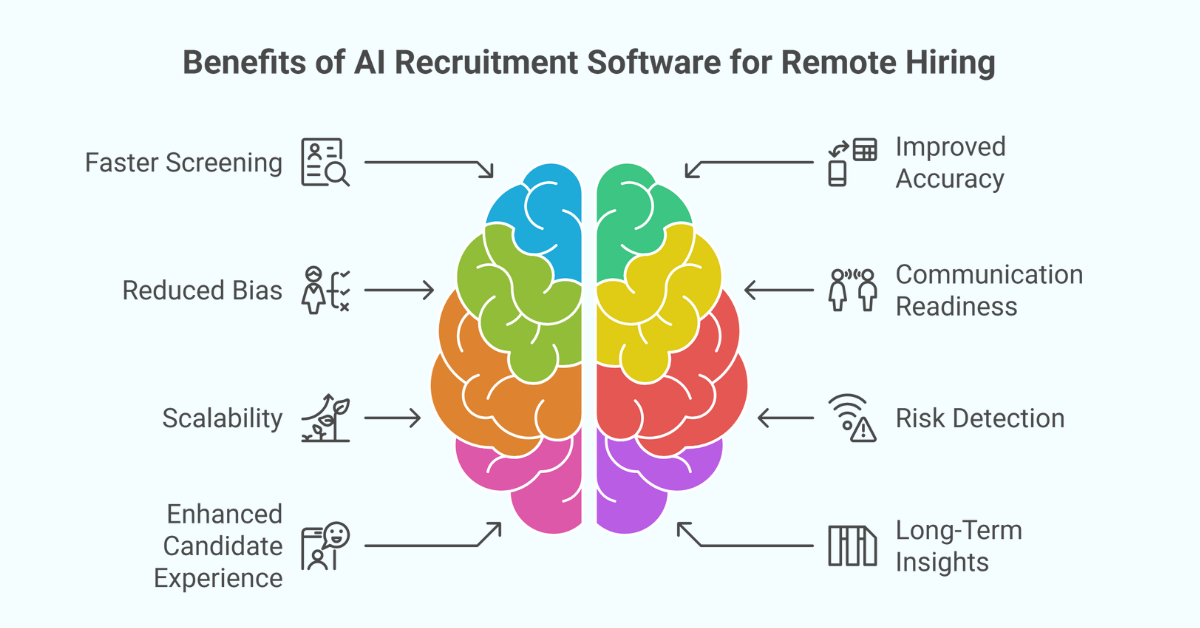
AI Recruitment Software is transforming how employers hire remotely by improving accuracy, speed, and fairness while helping teams identify real talent beyond resumes. Remote Recruit brings these benefits together in one global hiring platform.
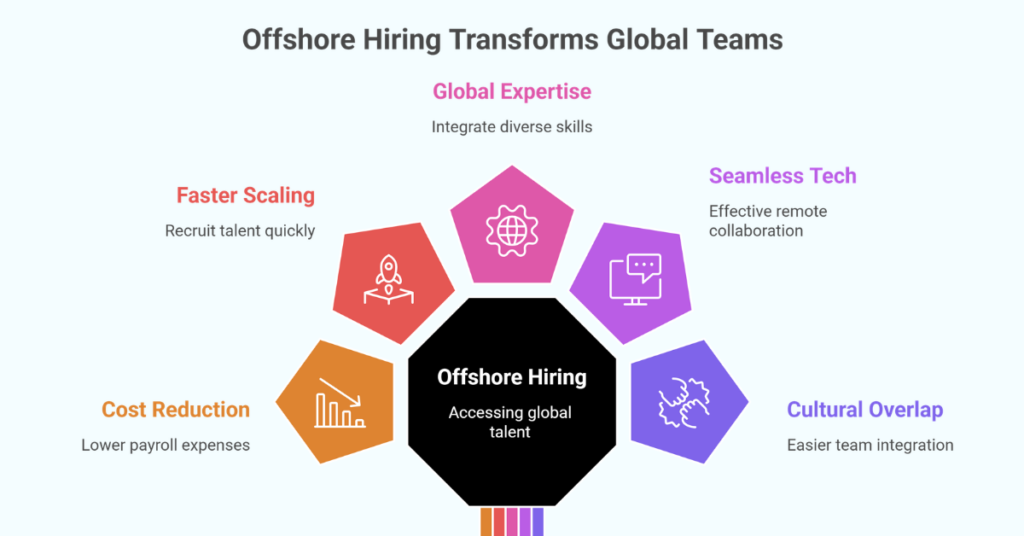
Remote hiring has become a permanent reality for employers across industries. Companies are no longer limited to hiring within commuting distance of an office, and global talent pools are now accessible to businesses of all sizes. While this shift creates opportunity, it also introduces complexity. Employers must screen larger volumes of applicants, evaluate candidates they may never meet in person, and ensure fairness and accuracy across borders. Traditional hiring methods struggle to keep up with these demands. According to global hiring research, recruiters spend an average of several seconds reviewing a resume, which increases the risk of missed talent and unconscious bias. AI Recruitment Software addresses these challenges by automating repetitive tasks, applying consistent evaluation criteria, and surfacing the most relevant candidates faster. For remote hiring in particular, AI-powered tools help employers move from guesswork to data-driven decision-making. When implemented correctly, AI Recruitment Software improves hiring quality, reduces time to hire, and creates a more scalable and fair recruitment process for distributed teams.
1. Faster Screening of High Application Volumes
Remote roles attract significantly more applicants than local positions, often overwhelming hiring teams. AI Recruitment Software helps manage this volume without sacrificing quality.
1. Automated resume and application screening
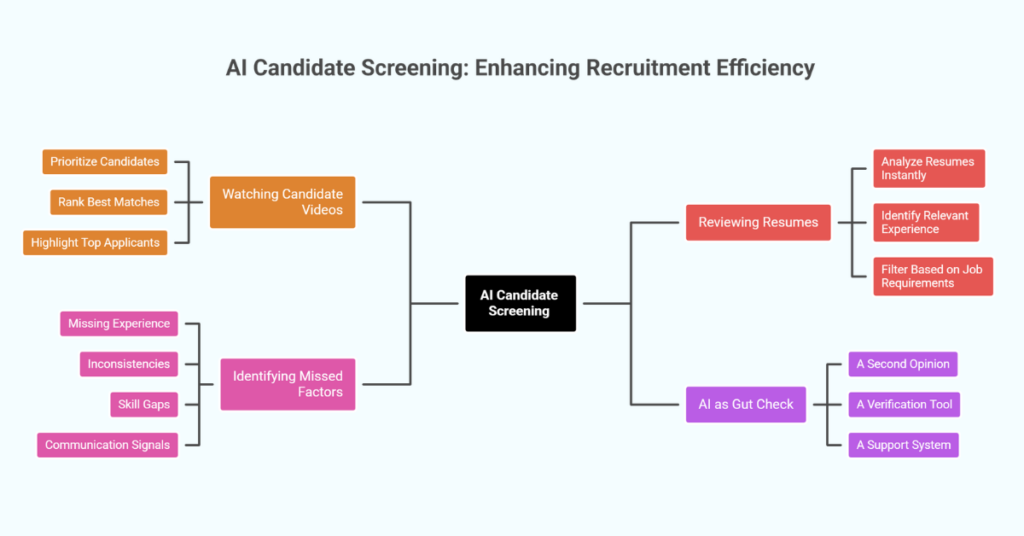
AI Recruitment Software can analyze thousands of applications in minutes by identifying skills, experience, and role alignment. This reduces the manual workload for recruiters and ensures that no qualified candidate is overlooked due to time constraints. Automated screening prioritizes candidates based on relevance rather than keywords alone. Employers benefit from shorter hiring cycles and faster access to top talent. Speed is critical in remote hiring, where strong candidates often receive multiple offers.
2. Improved Hiring Accuracy Through Data-Driven Insights
Hiring decisions based purely on intuition or limited information increase the risk of poor outcomes. AI Recruitment Software introduces data-backed evaluation into the process.
2. Consistent candidate scoring and ranking
AI tools assess candidates using predefined criteria such as skills, experience, communication signals, and role fit. This creates a standardized comparison across all applicants. Hiring managers gain clearer insight into why candidates are ranked higher or lower. Data-driven scoring reduces guesswork and improves confidence in decisions. Over time, these insights help employers refine hiring criteria and improve overall hiring accuracy.
3. Reduced Bias in Remote Hiring Decisions
Bias remains one of the biggest challenges in recruitment, especially when hiring globally. AI Recruitment Software helps minimize unconscious bias in early screening stages.
3. Objective evaluation based on skills and signals
AI Recruitment Software focuses on measurable attributes rather than names, locations, or backgrounds. By applying the same criteria to every applicant, it reduces the influence of subjective judgment. This creates a more equitable hiring process for candidates from different regions. Reduced bias leads to more diverse teams and better business outcomes. Fair hiring practices also strengthen employer brand and candidate trust.
4. Better Identification of Communication Readiness
Communication is critical for remote roles, yet it is often difficult to assess through resumes alone. AI Recruitment Software helps surface communication-related signals earlier.
4. Analysis of written and behavioral patterns
AI tools evaluate how candidates respond to questions, structure answers, and follow instructions. This provides insight into clarity, consistency, and professionalism. Employers can identify candidates who are better prepared for remote collaboration. Early communication screening reduces the risk of hiring individuals who struggle with distributed work environments. Strong communication readiness leads to smoother onboarding and team integration.
5. Scalability Without Increasing Hiring Costs
As companies grow, hiring needs often increase faster than recruiting resources. AI Recruitment Software enables scalable hiring without linear cost growth.
5. High-volume hiring support at scale
AI can screen large candidate pools consistently without requiring additional recruiters. This allows companies to expand remote teams efficiently. Employers maintain quality while controlling costs. Scalable hiring processes are especially valuable for startups and fast-growing organizations. AI Recruitment Software ensures growth does not compromise hiring standards.
6. Early Detection of Risk and Low-Quality Applications
Not all applicants are equally serious or qualified, especially in remote hiring where mass applications are common. AI Recruitment Software helps identify potential risks early.
6. Detection of low-effort or inconsistent applications
AI tools flag patterns associated with generic responses, automation, or misrepresentation. This allows recruiters to focus on candidates who demonstrate genuine effort and alignment. Early risk detection reduces wasted interview time. Employers avoid progressing candidates who are unlikely to perform or stay long term. This improves overall hiring efficiency and retention.
7. Enhanced Candidate Experience Through Faster Feedback
Candidate experience plays a major role in employer reputation and offer acceptance. AI Recruitment Software improves responsiveness and transparency.
7. Faster shortlisting and communication
Automated workflows enable quicker updates and decisions. Candidates receive feedback sooner, reducing uncertainty and frustration. Faster processes increase acceptance rates among top candidates. A positive experience also encourages candidates to reapply or recommend the employer. Strong candidate experience supports long-term talent pipelines.
8. Better Long-Term Hiring Insights and Optimization
AI Recruitment Software does more than fill roles. It helps employers learn and improve over time.
8. Performance and hiring trend analysis
AI tools track hiring outcomes, time to hire, and candidate quality metrics. Employers can identify what works and what needs improvement. These insights inform future hiring strategies and workforce planning. Continuous optimization leads to better long-term hiring results. Data-driven learning is essential for sustainable remote hiring success.
How Remote Recruit Uses AI Recruitment Software to Support Employers and Job Seekers
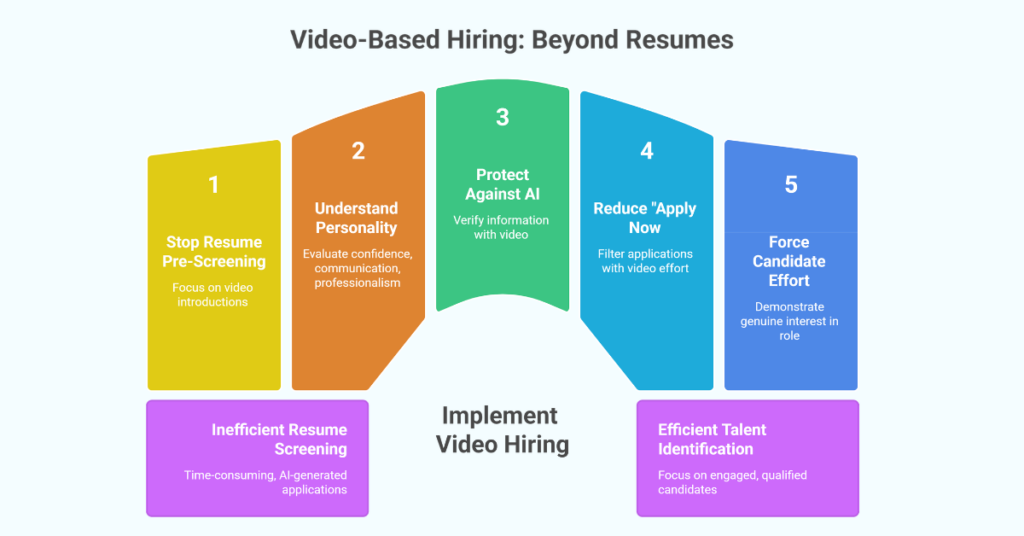
Remote Recruit combines AI Recruitment Software with video-based hiring to create a balanced and human-centered recruitment experience. For employers, the platform automates early screening, ranks candidates objectively, and highlights communication readiness before interviews begin. This reduces hiring risk while saving time and resources. Employers gain visibility into global talent pools without relying solely on resumes.
Remote Recruit also integrates video profiles, allowing hiring teams to validate AI insights with real human interaction. This ensures decisions are informed by both data and personal connection. Employers can scale remote hiring while maintaining quality and fairness.
For job seekers, Remote Recruit provides a transparent and equitable hiring experience. Candidates are evaluated based on skills, communication, and effort rather than geography or assumptions. Video profiles allow professionals to present themselves authentically and stand out in remote hiring processes. By verifying employers and candidates, Remote Recruit builds trust on both sides of the hiring journey.
Conclusion
AI Recruitment Software has become essential for employers hiring in a remote and global environment. It addresses the limitations of traditional recruitment by improving speed, accuracy, and fairness. From handling high application volumes to reducing bias and improving communication screening, AI-powered tools help employers make better hiring decisions with confidence.
As remote work continues to expand, companies that rely solely on manual hiring processes will struggle to compete. AI Recruitment Software enables scalable growth without sacrificing quality. Platforms like Remote Recruit demonstrate how AI can be combined with human insight to create a smarter hiring experience. By adopting AI-driven recruitment, employers position themselves to build stronger teams, improve retention, and succeed in an increasingly distributed workforce.
Frequently Asked Questions
What is AI Recruitment Software?
AI Recruitment Software uses artificial intelligence to automate and improve hiring tasks such as screening, ranking, and evaluating candidates.
How does AI Recruitment Software help with remote hiring?
It manages high application volumes, applies consistent evaluation criteria, and surfaces qualified candidates faster across global talent pools.
Does AI Recruitment Software replace human recruiters?
No. AI supports recruiters by handling repetitive tasks and providing insights, allowing humans to focus on interviews and decision-making.
Can AI Recruitment Software reduce hiring bias?
Yes. By evaluating candidates based on consistent criteria, AI reduces the impact of unconscious bias in early screening stages.
How does Remote Recruit use AI Recruitment Software?
Remote Recruit combines AI screening with video-based evaluation and job seeker and employer verification to deliver fair, efficient, and effective remote hiring.