Global Remote Recruitment gives job seekers access to international career opportunities, but standing out requires strong communication, video profiles, credible skills, and a professional digital presence.
Global Remote Recruitment has changed the way professionals search for jobs, build careers, and connect with employers across borders. Job seekers are no longer limited to companies in their city or country. They can now apply for remote job opportunities with global employers, access better roles, and compete in international talent markets. However, this opportunity also brings greater competition. A remote job posting can attract applicants from multiple countries, backgrounds, and skill levels, which means job seekers must do more than upload a standard resume and wait for a response. Employers hiring remotely are looking for communication skills, reliability, self-discipline, digital confidence, and proof that a candidate can succeed without office supervision. They also want candidates who can present themselves clearly through modern hiring tools such as video profiles and AI-powered screening workflows. To stand out in Global Remote Recruitment, job seekers need a stronger strategy. They must show their skills, demonstrate professionalism, build trust, and communicate their value in ways that match the expectations of remote employers.
1. Understand How Global Remote Recruitment Has Changed Job Search
Global Remote Recruitment has created new career opportunities, but it has also made job search more competitive. Candidates now compete not only with local applicants, but also with professionals from different countries and regions.
This means job seekers must think differently about how they present themselves. A traditional resume may not be enough when employers are reviewing large volumes of global applications. Remote employers need to quickly understand whether a candidate has the right skills, communication ability, and work habits for a distributed team. Job seekers who understand this shift can prepare stronger applications that speak directly to employer concerns. The goal is not only to show experience, but to prove remote readiness, professionalism, and trustworthiness.
2. Build a Resume That Is Clear, Specific, and Remote-Focused
A strong resume is still important, but it must be adapted for remote job opportunities. Employers should be able to quickly understand your skills, achievements, tools, and ability to work independently.
Remote job seekers should avoid vague descriptions and focus on measurable results wherever possible. Instead of simply listing responsibilities, explain what you improved, delivered, supported, or managed. Mention remote-friendly skills such as project management, written communication, digital collaboration, time management, and experience using online tools. A clear resume helps AI candidate screening systems and recruiters identify your relevance faster. In Global Remote Recruitment, clarity can be the difference between being shortlisted and being ignored.
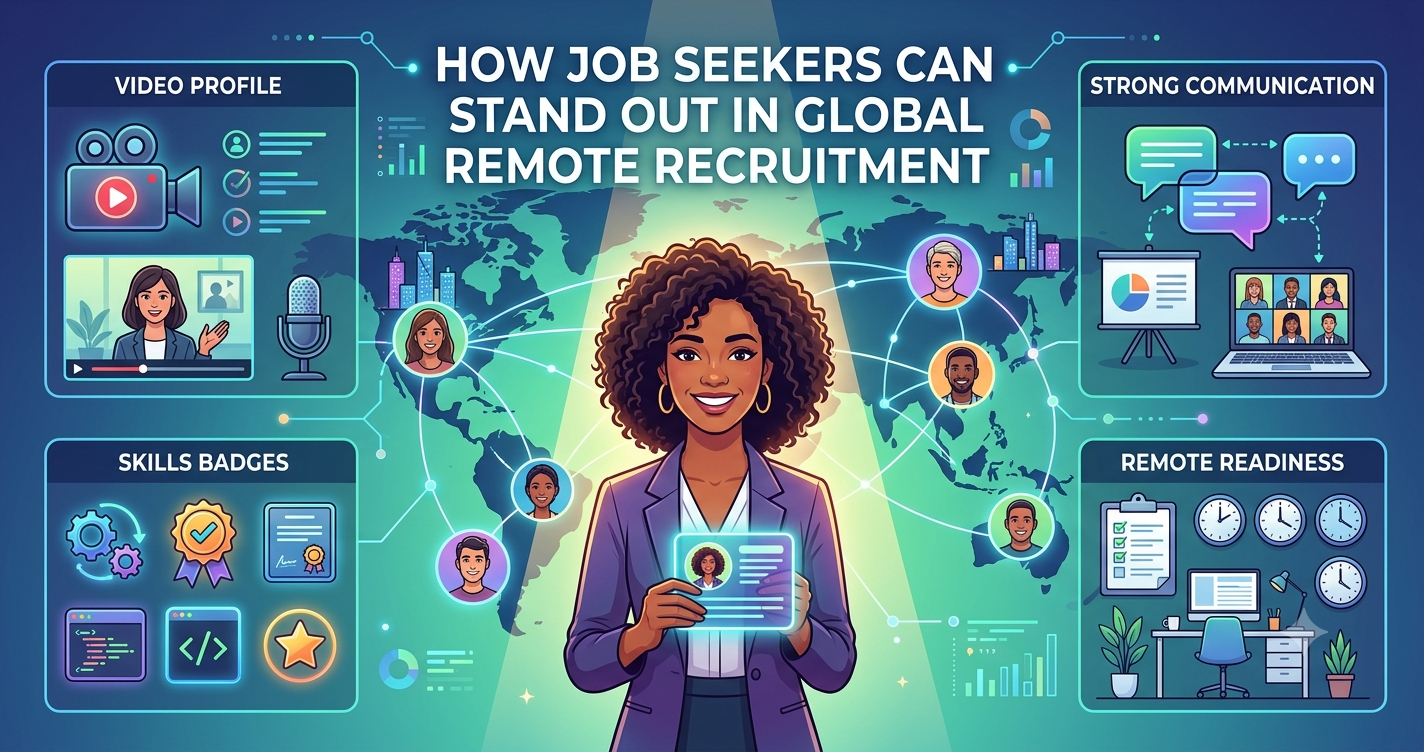
3. Use Video Profiles to Show Communication and Personality
Video profiles are becoming increasingly important because employers want to evaluate candidates beyond text-based resumes. A resume shows qualifications, but a video can show communication style, confidence, professionalism, and motivation.
Job seekers should use video profiles to introduce themselves clearly and explain why they are suitable for remote work. The video does not need to be overly polished, but it should be professional, focused, and easy to understand. Speak naturally, maintain good lighting, use a quiet background, and keep the message relevant to the type of roles you want. Video profiles help candidates create trust with global employers who may never meet them in person. In a crowded remote hiring market, a strong video profile can make your application more memorable.
4. Show That You Are Ready for Remote Work
Employers hiring remotely want candidates who can work independently, communicate proactively, and stay productive without constant supervision. Remote readiness is now one of the most valuable signals in Global Remote Recruitment.
Job seekers should highlight examples that prove they can manage responsibilities in a distributed work environment. This may include working across time zones, using collaboration tools, managing deadlines independently, or communicating with international teams. Employers want to know that you can stay organized, solve problems, and remain accountable outside a traditional office setting. You can show this through your resume, video profile, application responses, and interviews. The more clearly you demonstrate remote readiness, the easier it becomes for employers to trust your ability to perform.
5. Improve Your Digital Communication Skills
Communication is one of the most important skills for remote job seekers. Since remote teams rely on digital tools, your writing, speaking, and response habits can strongly influence hiring decisions.
Global employers look for candidates who can explain ideas clearly, ask thoughtful questions, and communicate updates without confusion. Your emails, application responses, video profile, and interview answers all show how you may communicate on the job. Avoid unclear messages, overly casual language, and generic answers that do not show preparation. Practice explaining your experience in a structured way, using simple examples and direct language. Strong communication helps employers feel confident that you can collaborate effectively in a remote team.
6. Tailor Each Application to the Role
Many job seekers apply to remote roles using the same resume and generic message for every opportunity. This approach rarely works well in Global Remote Recruitment because employers are looking for specific alignment.
Before applying, read the job description carefully and identify the most important skills, tools, and responsibilities. Then adjust your resume, profile summary, and application answers to match the role. This does not mean exaggerating your experience. It means making your most relevant strengths easier for employers to see. Tailored applications perform better because they show effort, attention to detail, and genuine interest. Employers are more likely to respond when they can quickly understand why you are a strong fit.
7. Build Trust With a Professional Online Presence
Trust is a major factor in remote hiring because employers may be evaluating candidates from countries they are not familiar with. A professional digital presence can help remove uncertainty and make you more credible.
Job seekers should keep their online profiles consistent, updated, and aligned with the roles they want. Your resume, job platform profile, video introduction, and professional social profiles should tell the same story. Avoid conflicting job titles, unclear employment dates, or incomplete information that may create doubts. Add proof where possible, such as portfolios, certifications, work samples, or project examples. In Global Remote Recruitment, trust is built through consistency, transparency, and professionalism.
8. Highlight Skills That Global Employers Actually Value
Remote employers look for more than technical qualifications. They want candidates who can work well across distance, cultures, and time zones.
Important skills include communication, reliability, problem-solving, adaptability, ownership, and digital collaboration. Job seekers should show these skills through real examples rather than simply listing them. For example, mention how you managed deadlines with a distributed team or supported clients in different regions. Employers want evidence that you can perform in a global work environment. When your profile reflects both hard skills and remote work strengths, you become more attractive to international employers.
9. Prepare for AI Candidate Screening
AI candidate screening is increasingly used to help employers manage large application volumes. This means job seekers must make their profiles clear, relevant, and easy to evaluate.
Use role-specific keywords naturally in your resume and profile, especially skills, tools, job titles, and industry terms related to the roles you want. Avoid overly designed resumes that are difficult to read or filled with unclear formatting. Make sure your experience is specific, structured, and aligned with the job description. AI candidate screening does not replace human review, but it can influence whether your application reaches the next stage. A clear and relevant application helps both AI systems and recruiters understand your fit faster.
10. Avoid Common Mistakes That Reduce Your Chances
Many remote job seekers miss opportunities because of avoidable mistakes. These mistakes can make strong candidates appear less prepared or less professional than they really are.
Common issues include applying without reading the job description, using generic cover messages, ignoring time zone requirements, submitting incomplete profiles, and failing to explain remote work readiness. Poor communication during the hiring process can also hurt your chances. Employers may see slow replies, unclear answers, or missed instructions as signs of how you may work after being hired. Job seekers should treat every application as a professional interaction. Small details matter because remote employers often rely on digital signals to judge reliability and fit.
11. Practical Tips for Job Seekers in Global Remote Recruitment
Standing out in Global Remote Recruitment requires a mix of strategy, presentation, and consistency. Job seekers should focus on making it easy for employers to understand their value and trust their ability to work remotely.
1. Create a strong remote-ready profile
Your profile should clearly explain who you are, what roles you are targeting, and why you are suitable for remote work. Include your key skills, tools, industries, work style, and experience with distributed teams if available. A strong profile helps employers quickly understand your professional identity. It also helps AI candidate screening systems match you with relevant opportunities. A complete and focused profile gives you a better chance of being noticed in a crowded global talent pool.
2. Record a professional video introduction
A video introduction can help you stand out because it shows communication skills, confidence, and personality. Keep your message clear, focused, and relevant to the roles you want. Mention your experience, strengths, and why you are interested in remote opportunities. Use a quiet environment, good lighting, and professional language to create a strong impression. Video profiles are especially powerful in remote hiring because they help employers build trust before the first interview.
3. Apply only to roles that match your skills
Applying to every remote job may feel productive, but it often leads to weak results. Employers can usually tell when a candidate has not read the role carefully or does not match the requirements. Focus on jobs where your skills, experience, time zone, and availability are genuinely aligned. This allows you to submit stronger applications with better customization. Quality applications are more effective than high-volume applications in Global Remote Recruitment.
4. Show proof of your work wherever possible
Work samples, portfolios, case studies, certifications, and project examples can help employers trust your abilities. This is especially useful when applying to global employers who may not know your previous companies or local market. Proof gives your application more credibility and makes your skills easier to evaluate. Even simple examples of completed projects can make a strong difference. Remote employers appreciate candidates who make evaluation easier and more transparent.
5. Respond quickly and professionally
Timely communication matters in remote recruitment because employers use it as a signal of reliability. Reply to messages clearly, follow instructions carefully, and keep your tone professional. If you need more time, communicate that respectfully instead of disappearing. Strong communication during hiring builds confidence and shows that you understand remote work expectations. Professional responsiveness can help you stand out even when other candidates have similar qualifications.
How Remote Recruit Supports Employers and Job Seekers
Remote Recruit helps job seekers and employers succeed in the modern world of Global Remote Recruitment. For job seekers, the platform provides a professional way to showcase skills, experience, communication ability, and personality through video profiles. This helps candidates stand out beyond traditional resumes and create stronger first impressions with global employers. Remote Recruit also supports better visibility for professionals who want access to remote job opportunities across borders.
For employers, Remote Recruit provides a smarter way to evaluate global talent with AI candidate screening, video-based hiring, and structured remote recruitment workflows. Employers can identify relevant candidates faster, assess communication earlier, and reduce the limitations of resume-only hiring. This is especially useful when building remote teams, hiring offshore talent, or recruiting across multiple countries.
Remote Recruit is designed to create trust on both sides of the hiring process. Job seekers can present themselves more professionally, while employers gain better tools to evaluate real potential. By combining AI, video profiles, and global hiring technology, Remote Recruit helps make remote recruitment more transparent, efficient, and human.
Conclusion
Global Remote Recruitment has created life-changing opportunities for job seekers, but it has also raised the standard for how candidates must present themselves. Employers now receive applications from professionals across many countries, which means standing out requires more than a basic resume. Candidates must show skills, communication ability, remote readiness, professionalism, and trustworthiness from the beginning of the hiring process.
The strongest job seekers understand that remote hiring is different from traditional hiring. They tailor applications, create clear profiles, use video introductions, communicate professionally, and show proof of their work. These actions help employers see not only what they have done, but also how they may perform in a remote team.
Remote Recruit supports this new reality by helping candidates showcase themselves more effectively and helping employers evaluate global talent with better tools. As remote work continues to expand, job seekers who adapt to modern hiring expectations will have a stronger chance of accessing better roles, better companies, and better long-term career opportunities.
Frequently Asked Questions
What is Global Remote Recruitment?
Global Remote Recruitment is the process of hiring or applying for remote roles across countries and regions. It allows employers to access international talent and helps job seekers find opportunities beyond their local job market.
How can job seekers stand out in Global Remote Recruitment?
Job seekers can stand out by creating a strong profile, tailoring applications, using video profiles, showing proof of work, and communicating clearly throughout the hiring process.
Why are video profiles important for remote job seekers?
Video profiles help job seekers show communication skills, confidence, personality, and professionalism. They give employers a better understanding of the candidate beyond a traditional resume.
How does AI candidate screening affect job seekers?
AI candidate screening helps employers review applications faster and identify relevant candidates. Job seekers can improve their chances by using clear formatting, relevant keywords, and specific experience aligned with the job description.
What do global employers look for in remote candidates?
Global employers look for technical skills, communication ability, reliability, self-management, adaptability, and proof that a candidate can succeed in a remote environment.
How does Remote Recruit help job seekers find remote opportunities?
Remote Recruit helps job seekers create stronger profiles, showcase themselves through video, and connect with global employers looking for remote talent.
Sign up on Remote Recruit today to showcase your skills, discover global remote job opportunities, and stand out in the future of work.