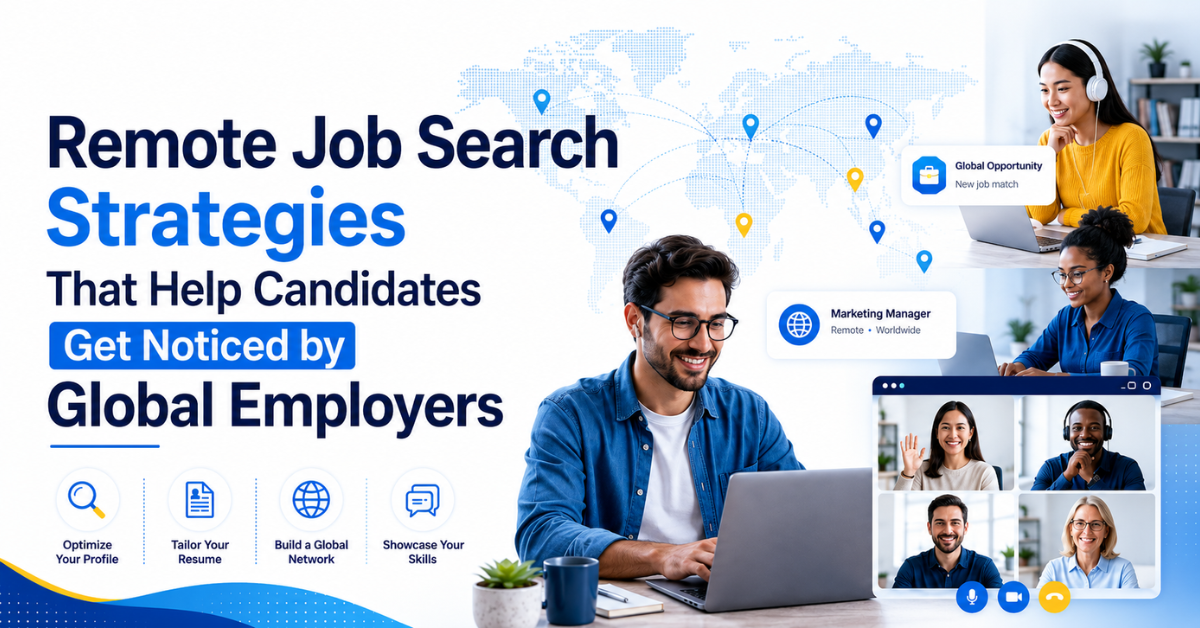
Global Remote Jobs are creating new career opportunities for skilled candidates who know how to position themselves, communicate their value, and stand out to employers hiring across borders.
Finding Global Remote Jobs is no longer just about applying to as many openings as possible. Candidates today are competing in a much larger talent market where employers can review applications from different cities, countries, and time zones. This creates more opportunity, but it also means job seekers need a smarter and more focused approach. A strong resume, a complete profile, clear communication skills, and proof of remote work readiness can make a major difference.
Global employers are not only looking for skills. They want candidates who can work independently, communicate clearly, manage deadlines, collaborate online, and contribute to business goals without needing constant supervision. According to the World Economic Forum’s Future of Jobs Report 2025, global employers are planning for major workforce transformation between 2025 and 2030, with digital access and skills change influencing how companies hire and develop talent.
This means candidates who understand how remote hiring works can position themselves better. Whether you are searching for international remote jobs, applying through a remote hiring platform, or trying to get noticed by global employers, your strategy should show credibility, confidence, and readiness. The goal is not just to apply. The goal is to make employers believe you can deliver results from anywhere.
1. Understand What Global Employers Look for in Remote Candidates
Before applying for Global Remote Jobs, candidates need to understand how global employers evaluate remote talent. Hiring teams often receive a high volume of applications, so they quickly look for signals that show whether a candidate is reliable, skilled, and suitable for remote work. This includes your technical ability, communication style, work history, availability, and ability to adapt to different cultures and teams.
1.1. Skills that match the job role
Global employers want candidates who clearly match the responsibilities listed in the job description. If a company is hiring for a digital marketing, sales, customer support, finance, software development, or virtual assistant role, your profile should highlight the exact skills connected to that position. Avoid using a generic resume for every job because it makes it harder for hiring teams to see your fit. Instead, customize your profile to show how your past experience connects to the role you want.
1.2. Strong written communication
Remote work depends heavily on written communication because teams often collaborate through email, chat, project tools, and documentation. Employers pay close attention to how clearly you write in your resume, profile summary, cover letter, and application answers. If your writing is confusing, too casual, or filled with errors, it can create doubt about your ability to work remotely. Clear and professional communication helps employers trust that you can explain ideas, ask questions, and update teams without confusion.
1.3. Reliability and accountability
Global employers want candidates who can work without constant supervision. This means they look for signs that you can manage your time, meet deadlines, take ownership, and follow through on tasks. Your resume should include examples where you handled projects, supported teams, improved processes, or achieved measurable results. When you show accountability, employers are more likely to believe you can succeed in a remote role.
1.4. Remote work readiness
Not every skilled candidate is ready for remote work, so employers look for evidence that you understand the remote work environment. Mention tools you have used, such as video meeting platforms, project management systems, CRM platforms, reporting dashboards, or collaboration software. You can also highlight experience working with international teams, flexible hours, asynchronous communication, or independent project delivery. These details make your application stronger because they reduce the employer’s perceived hiring risk.
2. Build a Resume That Is Optimized for Global Remote Jobs
Your resume is often the first thing global employers see, so it should quickly communicate your value. A remote job resume should not only list your previous responsibilities. It should show results, skills, tools, and proof that you can work effectively with distributed teams. A well-structured resume can help you pass initial screening and make recruiters more interested in your profile.
2.1. Add a strong professional summary
Your professional summary should explain who you are, what you specialize in, and what kind of remote role you are targeting. Keep it focused on the value you bring to employers rather than only describing your career history. For example, instead of saying you are looking for a remote job, explain how your skills can help a global employer solve business problems. A strong summary makes your resume more relevant within the first few seconds.
2.2. Use keywords from the job description
Many employers use screening systems or structured review processes to shortlist candidates. That is why your resume should include relevant keywords from the job description, such as project management, lead generation, customer support, financial analysis, content marketing, Python, CRM, reporting, or data analysis. Do not stuff keywords unnaturally, but use them where they fit your real experience. This helps your resume appear more aligned with the role.
2.3. Highlight measurable achievements
Global employers are more impressed by results than general responsibilities. Instead of writing that you managed social media, mention growth in engagement, leads, traffic, or conversions if you have the data. Instead of saying you supported customers, mention response time, satisfaction scores, ticket volume, or retention impact if available. Numbers make your profile more credible and help employers understand the value you can bring.
2.4. Include remote-friendly tools
Employers hiring for international remote jobs want to know whether you can use common digital work tools. Add tools such as Slack, Zoom, Google Workspace, Microsoft Teams, Trello, Asana, HubSpot, Salesforce, Excel, Power BI, Notion, Jira, or other platforms relevant to your profession. This shows that you can adapt quickly to a remote setup. It also helps employers compare your readiness with other candidates.
3. Create a Strong Online Profile That Builds Employer Trust
When applying for Global Remote Jobs, your online profile can be as important as your resume. Employers often review profiles to understand your background, professionalism, and communication style. A complete and well-written profile can help you stand out from candidates who only submit basic information. It also gives recruiters more confidence before shortlisting you.
3.1. Use a clear headline
Your headline should immediately explain your role and value. Instead of using a vague headline like “Looking for Remote Work,” write something more specific such as “Remote Digital Marketing Specialist Helping B2B Brands Generate Leads.” A clear headline helps employers understand your positioning quickly. It also improves your chances of appearing in relevant searches on remote hiring platforms.
3.2. Write a value-driven profile summary
Your profile summary should focus on what you can do for employers. Explain your key skills, your experience, your strongest achievements, and the type of global remote jobs you are targeting. Keep the tone professional, confident, and easy to read. A good summary should make the employer feel that you understand their needs and can contribute from day one.
3.3. Add portfolio links or work samples
Work samples are powerful because they allow employers to see proof of your skills. Depending on your role, you can add writing samples, design work, dashboards, campaign reports, case studies, code repositories, sales scripts, customer service examples, or project summaries. Even if you cannot share confidential work, you can create sample projects that show your ability. A portfolio helps you move from being a name on a list to a candidate with visible proof.
3.4. Keep your profile complete and updated
Incomplete profiles can make employers question your seriousness. Make sure your work history, skills, availability, location, time zone, salary expectations, and contact details are accurate. Update your profile regularly with new achievements, certifications, tools, and projects. A complete profile improves your chances of being discovered by global employers and remote hiring platforms.
4. Use a Video Profile to Stand Out from Other Candidates
Video profiles are becoming more useful in remote hiring because they help employers assess communication before scheduling interviews. For Global Remote Jobs, this can be a major advantage. A short, professional video can show your confidence, clarity, personality, and ability to explain your experience. It gives employers a better sense of who you are beyond your resume.
4.1. Keep your video short and focused
A good video profile should be concise and structured. Start with your name, your professional background, your key skills, and the type of remote role you are interested in. Avoid speaking for too long or repeating your entire resume. The goal is to create a strong first impression that encourages employers to review the rest of your profile.
4.2. Speak clearly and professionally
Remote employers need candidates who can communicate well on video calls. Your video profile should show that you can speak clearly, organize your thoughts, and present yourself professionally. Use simple language, maintain good posture, and avoid background noise. This gives employers confidence that you can participate in remote meetings and communicate with international teams.
4.3. Explain why you are ready for remote work
Use your video profile to show that you understand the expectations of remote work. Mention your ability to manage time, collaborate online, meet deadlines, and work across time zones. If you have previous remote experience, briefly explain how you handled communication and delivery. This helps employers see you as a lower-risk candidate for remote hiring.
4.4. Show confidence without sounding scripted
Employers want to see your personality, not just hear memorized lines. Prepare your key points, but speak naturally and confidently. A video that feels too robotic may not create the right impression. A natural and professional tone helps employers connect with you and remember your profile.
5. Apply Strategically Instead of Applying Everywhere
Many job seekers make the mistake of applying to every remote job they find. This may feel productive, but it often leads to low response rates. A better strategy is to apply to roles that closely match your skills, experience, salary expectations, and working style. Quality applications usually perform better than high-volume applications.
5.1. Focus on roles where you meet most requirements
You do not need to match every requirement, but you should meet the most important ones. If a role requires strong experience in a specific tool, industry, or function, make sure your application clearly shows that connection. Applying to jobs where you are a strong match increases your chances of getting shortlisted. It also helps you spend more time creating better applications.
5.2. Customize your application for each employer
A customized application shows effort and interest. Mention the role, the company’s needs, and how your experience can help solve their problems. Avoid sending the same generic message to every employer. When your application feels relevant, employers are more likely to read it carefully.
5.3. Apply early when possible
Remote jobs can receive applications quickly because candidates from different countries may apply. Applying early can help your profile appear before the employer is overwhelmed with submissions. Set up alerts for international remote jobs that match your skills. A faster response can give you a better chance of being seen.
5.4. Track your applications
Create a simple tracker with the job title, company, application date, platform, status, follow-up date, and notes. This helps you stay organized and avoid applying to the same role multiple times. It also helps you understand which types of applications get responses. Over time, tracking allows you to improve your remote job search strategy.
6. Improve Your Cover Letter and Application Message
Your cover letter or application message should make the employer want to learn more about you. It does not need to be long, but it should be specific and relevant. For Global Remote Jobs, the best application messages explain why you are a good fit, how you can help, and why you are ready to work remotely. A strong message can separate you from candidates who only upload a resume.
6.1. Start with the employer’s need
Begin by showing that you understand the role. Mention the specific problem the employer may be trying to solve, such as improving customer response times, generating more leads, managing financial reports, supporting operations, or building software features. This makes your message more employer-focused. It shows that you are not just asking for a job, but offering a solution.
6.2. Connect your experience to the role
Use two or three sentences to explain your most relevant experience. Focus on achievements, tools, industries, or responsibilities that match the job description. Avoid listing everything you have done. The goal is to make the employer quickly see why your background fits the role.
6.3. Mention remote work strengths
Add a short line about your remote work readiness. You can mention your experience working independently, using collaboration tools, managing deadlines, or communicating across time zones. This is especially useful when applying to global employers. It reassures them that you understand how remote teams operate.
6.4. End with a clear next step
Close your message by showing interest in a conversation. Keep it polite and confident. For example, you can say that you would be happy to discuss how your skills can support the team’s goals. A simple and professional ending creates a better impression than a vague or desperate closing.
7. Prepare for Remote Interviews with Global Employers
Once you get shortlisted, the interview becomes your chance to prove that you can succeed in a remote role. Global employers often assess your skills, communication, problem-solving ability, and remote work habits. They may also evaluate whether you can work across cultures and time zones. Preparation is essential because remote interviews can move quickly.
7.1. Research the company and role
Before the interview, understand the company’s services, customers, industry, and hiring needs. Review the job description carefully and prepare examples that match the responsibilities. This allows you to answer questions with more confidence. Employers appreciate candidates who show preparation and genuine interest.
7.2. Prepare examples using real results
Use examples from your previous work to show how you solved problems or delivered results. Explain the situation, what you did, and what happened after your action. Whenever possible, include numbers such as revenue impact, time saved, leads generated, tickets resolved, costs reduced, or projects completed. Real examples make your answers more convincing.
7.3. Test your video setup
Remote interviews depend on a stable setup. Check your internet connection, camera, microphone, lighting, and background before the call. Join the meeting a few minutes early and make sure your display name is professional. A smooth setup shows respect for the employer’s time and strengthens your remote work image.
7.4. Ask smart questions
Good questions show that you are serious about the opportunity. Ask about team structure, communication style, performance expectations, time zone overlap, tools used, and onboarding process. These questions also help you understand whether the role is right for you. A thoughtful candidate is more memorable than someone who only answers questions.
8. Build Skills That Increase Your Chances of Getting Global Remote Jobs
The remote job market rewards candidates who keep improving their skills. Global employers often compare talent from multiple regions, so continuous learning can help you stay competitive. The World Economic Forum’s Future of Jobs Report 2025 highlights skills change as a major factor shaping the future workforce, with employers preparing for significant changes in jobs and required capabilities.
8.1. Strengthen digital skills
Digital skills are important for almost every remote role. Even non-technical positions often require comfort with online tools, reporting systems, automation platforms, spreadsheets, CRM systems, and communication software. The more confident you are with digital tools, the easier it is for employers to trust your ability to work remotely. Invest time in learning platforms and tools that are common in your target role.
8.2. Improve communication skills
Remote work depends on clear communication. Practice writing concise updates, summarizing tasks, asking better questions, and explaining problems clearly. Strong communication helps prevent delays and misunderstandings in distributed teams. Employers value candidates who can keep everyone aligned without needing constant follow-up.
8.3. Learn basic data and reporting
Many global employers want candidates who can make decisions using data. You do not need to be a data scientist for every role, but you should know how to read reports, track performance, and explain results. Skills in Excel, Google Sheets, dashboards, analytics, or CRM reporting can make you more valuable. Candidates who can show measurable impact often stand out faster.
8.4. Develop cross-cultural awareness
Global remote teams often include people from different countries and work cultures. Candidates who are respectful, adaptable, and aware of communication differences are more likely to succeed. Learn how to work with different time zones, meeting styles, feedback expectations, and decision-making processes. Cross-cultural awareness helps you build trust with international teams.
9. Common Mistakes That Stop Candidates from Getting Noticed
Many candidates are qualified but still struggle to get responses because of avoidable mistakes. These mistakes can make an application look incomplete, unclear, or unsuitable for remote work. By fixing them, job seekers can improve their chances of being shortlisted. Small changes in presentation and strategy can create a big difference.
9.1. Sending a generic resume
A generic resume makes it difficult for employers to understand why you are suitable for a specific role. If the same resume is used for marketing, operations, sales, and customer support jobs, it will not feel targeted. Employers want to see a clear connection between your experience and their needs. Tailoring your resume improves relevance and makes your application stronger.
9.2. Ignoring the profile summary
Some candidates leave their profile summary blank or write only one basic sentence. This is a missed opportunity because the summary is often one of the first sections employers read. A strong summary can explain your skills, achievements, and remote work readiness in a clear way. It helps employers decide whether to continue reviewing your profile.
9.3. Not showing proof of work
Employers may hesitate if they cannot see examples of your skills. A portfolio, case study, report, project sample, or video profile can make your application more credible. Proof of work is especially useful when applying for global remote jobs because employers may not know your previous companies. Visible examples help bridge that trust gap.
9.4. Poor follow-up habits
Following up can help, but it must be done professionally. Sending too many messages or sounding impatient can create a negative impression. A good follow-up should be polite, brief, and focused on your continued interest in the role. It can remind the employer about your profile without creating pressure.
10. How Remote Recruit Helps Employers and Job Seekers
Remote Recruit helps connect global employers with skilled remote candidates while making the hiring journey more efficient, transparent, and candidate-friendly. For employers, Remote Recruit provides access to a global talent pool, helping companies discover candidates across roles, locations, and skill sets. The platform supports smarter remote hiring by allowing employers to review candidate profiles, assess experience, and identify talent that fits their requirements. Features such as video profiles and AI-supported screening can help employers evaluate communication, confidence, and suitability before moving to interviews.
For job seekers, Remote Recruit creates a better way to get discovered by companies hiring remote talent. Candidates can build a professional profile, showcase their skills, highlight remote work readiness, and present themselves to employers looking beyond local hiring markets. This is especially valuable for candidates who want access to international remote jobs but need a platform that helps them stand out. Remote Recruit supports both sides of the hiring process by reducing friction, improving visibility, and helping the right candidates connect with the right employers. Whether you are a business looking for remote talent or a candidate searching for global remote jobs, Remote Recruit gives you a focused platform to move forward with confidence.
11. Tips to Improve Your Remote Job Search Results
A successful remote job search requires consistency, positioning, and continuous improvement. Candidates should treat the process like a professional campaign rather than a one-time activity. Every profile update, application, interview, and follow-up should help you learn what works. The more strategic you are, the better your chances of getting noticed by global employers.
11.1. Choose a clear target role
Trying to apply for too many unrelated roles can weaken your positioning. Choose one or two target roles where your skills are strongest. This helps you create a sharper resume, better profile summary, and more focused applications. Employers are more likely to trust candidates who know what they are good at.
11.2. Update your profile every month
Your profile should grow as your experience grows. Add new tools, projects, achievements, certifications, and portfolio samples regularly. This keeps your profile fresh and shows employers that you are active. A current profile is more attractive than one that looks outdated or unfinished.
11.3. Practice video introductions
A confident video introduction can help you perform better in interviews and video profiles. Practice explaining who you are, what you do, and how you can help employers in less than one minute. This builds clarity and confidence. It also helps you avoid nervous or unclear answers when speaking with global employers.
11.4. Keep learning from rejections
Rejections are part of the job search process, especially in a competitive remote market. Instead of taking them personally, review your resume, profile, application message, and interview answers. Look for patterns in the roles where you get responses and where you do not. This helps you improve your strategy over time.
12. Why Global Remote Jobs Are a Strong Opportunity for Candidates
Global Remote Jobs give candidates access to opportunities beyond their local job market. This can be especially valuable for skilled professionals in regions where local salaries, roles, or career paths may be limited. Remote work can help candidates connect with employers who value skills over location. It also allows companies to build more diverse and flexible teams.
Gallup’s research shows that many remote-capable employees prefer flexible work models, with six in 10 preferring hybrid arrangements and about one-third preferring fully remote work. Gallup also reported that fully remote workers globally had higher engagement than other work groups in its State of the Global Workplace insights.
For candidates, this means remote work is not only a convenience. It can be a serious career strategy when approached correctly. The best opportunities usually go to candidates who combine skill, professionalism, communication, and proof of performance.
13. Frequently Asked Questions About Global Remote Jobs
1. What are Global Remote Jobs?
Global Remote Jobs are roles that allow candidates to work for employers located in other cities, countries, or regions without needing to be physically present in an office. These jobs may be fully remote or may require some time zone overlap with the employer’s team. They are common in areas such as technology, marketing, sales, customer support, finance, design, administration, and operations. Candidates applying for these roles should show strong communication skills, digital tool knowledge, and the ability to work independently.
2. How can I get noticed by global employers?
To get noticed by global employers, you need a complete and targeted profile that clearly shows your skills, achievements, remote work readiness, and communication ability. Use a strong resume, a clear profile headline, relevant keywords, measurable results, and work samples where possible. A video profile can also help employers understand your personality and communication style before an interview. The more proof you provide, the easier it is for employers to trust your ability.
3. What should I include in my resume for Global Remote Jobs?
Your resume should include a professional summary, relevant skills, measurable achievements, work experience, remote-friendly tools, certifications, and examples of independent work. Make sure the resume matches the role you are applying for instead of using the same version for every job. Include keywords from the job description naturally so employers can quickly see your fit. A strong resume should show both your technical ability and your ability to work in a remote environment.
4. Are video profiles useful for remote job seekers?
Yes, video profiles can be very useful for remote job seekers because they help employers assess communication, confidence, and professionalism before scheduling interviews. A short video can make your profile more memorable and help you stand out from candidates who only submit a resume. It is especially helpful for roles that involve client communication, sales, support, marketing, or team collaboration. Keep the video clear, focused, and professional.
5. Which skills are most important for international remote jobs?
The most important skills depend on the role, but communication, time management, digital tool usage, problem-solving, accountability, and adaptability are valuable across most remote jobs. Role-specific skills such as coding, sales outreach, customer support, finance, content creation, data analysis, or project management are also important. Global employers often look for candidates who can work with limited supervision. Candidates who combine technical skills with strong remote work habits usually perform better.
6. How many remote jobs should I apply to each week?
There is no fixed number, but quality matters more than volume. It is better to apply to fewer relevant roles with customized applications than to send many generic applications. A practical approach is to identify roles where you meet most of the requirements and spend time tailoring your resume and message. Tracking your applications can also help you understand which roles and platforms are producing the best response rates.
7. Do global employers hire candidates from any country?
Some global employers hire candidates from many countries, while others may have restrictions based on time zones, legal requirements, payroll setup, language needs, or client coverage. Always read the job description carefully to understand location preferences. If the role allows international applicants, make sure your profile clearly mentions your location, time zone, availability, and ability to work with global teams. This helps employers assess fit faster.
8. How can Remote Recruit help me find Global Remote Jobs?
Remote Recruit helps job seekers create visibility with employers looking for remote talent. Candidates can build profiles that highlight skills, experience, video introductions, and remote work readiness. This gives employers more information than a traditional resume alone. By using Remote Recruit, candidates can improve their chances of being discovered by companies that are actively exploring global remote hiring.
Conclusion
Global Remote Jobs are opening new career pathways for candidates who are ready to compete in an international hiring market. However, opportunity alone is not enough. To get noticed by global employers, candidates need to present themselves with clarity, credibility, and confidence. A strong resume, optimized profile, video introduction, relevant work samples, and targeted applications can make a significant difference in the hiring process.
The remote job search should be treated as a strategy, not a guessing game. Candidates who understand employer expectations, highlight measurable achievements, communicate professionally, and show remote work readiness are more likely to stand out. The most successful applicants do not simply say they want remote work. They prove they can deliver value in a remote environment.
As global hiring continues to evolve, candidates who invest in skills, personal branding, and better application habits will be better positioned for international opportunities. Whether you are starting your remote job search or trying to improve your results, focus on quality, consistency, and proof of value. Sign up on Remote Recruit today to create your profile, showcase your skills, and connect with employers hiring remote talent across the world.