Offshore Hiring Solutions are becoming essential for employers that want to hire global talent faster, reduce screening delays, and evaluate remote candidates with more confidence.
Offshore recruitment has become a practical growth strategy for companies that want to access skilled talent, reduce hiring costs, and build flexible teams across different regions. Businesses are no longer limited by local talent shortages or high salary markets. They can now hire professionals from countries with strong talent pools in areas such as sales, customer support, finance, technology, marketing, operations, and administration.
However, offshore hiring also brings new challenges. Employers need to evaluate candidates across different countries, time zones, communication styles, salary expectations, and work cultures. Traditional hiring methods often struggle in this environment because resumes alone do not show communication ability, remote readiness, confidence, or long-term fit. This is why modern Offshore Hiring Solutions need better systems.
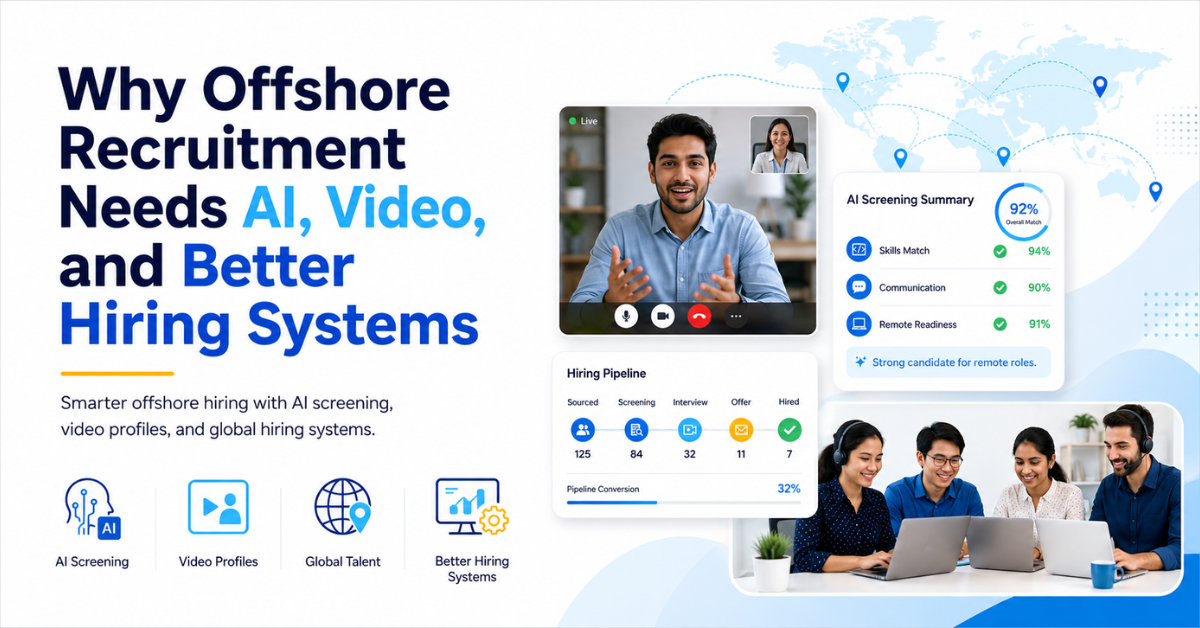
AI, video, and structured hiring platforms help employers make smarter decisions. AI candidate screening can reduce manual work, video-based hiring can show communication skills before interviews, and global hiring systems can organize the full recruitment process in one place. SHRM reported that AI adoption in HR tasks reached 43% in 2025, up from 26% in 2024, which shows how quickly companies are using AI to improve hiring efficiency.
1. Why Offshore Recruitment Is Growing
Offshore recruitment is growing because companies need more flexible ways to hire skilled people. Many employers are facing local talent shortages, rising hiring costs, and longer recruitment timelines. Offshore Hiring Solutions give businesses access to global candidates who may offer the right skills, availability, and cost structure for the role.
1.1. Employers need access to wider talent pools
Local hiring can limit employers to a small group of available candidates. When the right skills are not available locally, companies may delay projects or settle for weaker fits. Offshore recruitment helps employers access skilled professionals from different markets and compare candidates across a wider talent pool. This gives companies more choice and improves their ability to hire for specialized or high-demand roles.
1.2. Companies want more cost-effective hiring models
Hiring offshore talent can help companies manage recruitment costs while still building skilled teams. This is especially valuable for businesses that need to scale roles in sales, support, administration, finance, development, or marketing. Cost savings should not mean compromising on quality, which is why structured Offshore Hiring Solutions are important. A strong hiring system helps employers evaluate talent properly while maintaining budget control.
1.3. Remote work has made global hiring easier
Remote work has made it easier for companies to build distributed teams across locations. Many roles can now be performed effectively through online tools, video meetings, project platforms, and cloud-based systems. This has made offshore recruitment more practical for companies of different sizes. However, employers still need proper screening and evaluation methods to make sure candidates can succeed in a remote work environment.
1.4. Business growth requires faster hiring decisions
Companies that are growing cannot afford slow hiring processes. Delays in recruitment can affect sales targets, customer support quality, project delivery, and operational efficiency. Offshore recruitment can help employers find talent faster, but only if the process is organized. Better hiring systems allow companies to move from candidate discovery to shortlisting and interviews with less friction.
2. Why Traditional Offshore Recruitment Falls Short
Traditional offshore recruitment often depends on resumes, manual screening, and repeated interviews. This approach can work for smaller hiring needs, but it becomes inefficient when employers are hiring across countries or managing many applications. Offshore Hiring Solutions need modern tools that help recruiters evaluate candidates faster and more accurately.
2.1. Resumes do not show communication ability
A resume can show work history, qualifications, and skills, but it does not show how well a candidate communicates. This is a major issue in offshore recruitment because communication is often the foundation of remote team success. Employers need to know whether candidates can explain ideas clearly, join virtual meetings, and provide reliable updates. Video-based hiring helps fill this gap by allowing recruiters to assess communication before scheduling full interviews.
2.2. Manual screening takes too much time
Offshore recruitment can attract a large number of applicants from multiple regions. Manually reviewing every application can slow down the process and increase recruiter workload. It also creates a risk that strong candidates may be missed because recruiters are overwhelmed. AI candidate screening helps employers organize applications, identify better matches, and focus attention on candidates who are more relevant to the role.
2.3. Candidate quality can be difficult to compare
When candidates come from different countries, industries, and education systems, comparison can become difficult. A job title in one market may not mean the same thing in another market. Employers need structured hiring systems that help compare skills, experience, availability, salary expectations, and remote readiness. Without this structure, hiring decisions may become inconsistent or based too heavily on guesswork.
2.4. Interview overload slows hiring teams down
If employers interview too many candidates too early, hiring managers can quickly become overloaded. This can create fatigue, delay feedback, and reduce decision quality. A better offshore recruitment process should filter candidates before live interviews. AI screening and video profiles help employers focus interviews on candidates who already show stronger potential.
3. Why Offshore Hiring Solutions Need AI
AI is becoming an important part of modern hiring because it helps employers manage scale, speed, and consistency. In offshore recruitment, AI can support recruiters by organizing large candidate pools and helping identify profiles that match role requirements. The best use of AI is not to replace people, but to help hiring teams make better decisions with less manual work.
3.1. AI helps manage high application volume
Offshore job openings can attract candidates from many regions, which often increases application volume. AI candidate screening can help review structured candidate information and identify profiles that appear more relevant to the job requirements. This saves time for recruiters and helps them avoid spending hours on unsuitable applications. It also allows employers to respond faster to stronger candidates before they move on to other opportunities.
3.2. AI improves screening consistency
Manual screening can vary depending on the recruiter, workload, urgency, or interpretation of the job description. AI-supported screening helps apply more consistent criteria across candidates. This is useful when employers are comparing applicants from different markets and backgrounds. A more consistent process can improve fairness and help hiring teams stay focused on the skills and qualities that matter most.
3.3. AI helps identify role fit faster
AI can support role matching by reviewing skills, experience, keywords, qualifications, and profile data against employer requirements. This helps recruiters move faster from a large applicant pool to a practical shortlist. For offshore recruitment, this is valuable because speed can affect candidate quality. SHRM reported that nearly 9 in 10 HR professionals whose organizations use AI for recruiting say it saves time or increases efficiency.
3.4. AI supports better hiring decisions with data
AI candidate screening can help organize hiring information into clearer signals. Instead of relying only on unstructured resumes, employers can review skills, experience, location, availability, and screening insights in one place. This makes hiring conversations more structured and easier to explain. Data-supported hiring helps companies reduce confusion and make decisions with more confidence.
4. Why Offshore Recruitment Needs Video-Based Hiring
Video-based hiring gives employers a better way to evaluate candidates before live interviews. This is especially useful in offshore recruitment because companies are often hiring people they may never meet in person. Video profiles and recorded introductions help employers understand communication, confidence, personality, and remote work readiness earlier in the process.
4.1. Video shows how candidates communicate
Communication is one of the most important qualities in offshore hiring. Candidates need to explain updates, ask questions, join meetings, and collaborate with teams across locations. Video-based hiring allows employers to see how candidates present themselves before arranging interviews. This can be useful for roles in sales, support, marketing, operations, recruitment, customer success, and administration.
4.2. Video builds trust before interviews
Hiring offshore talent requires trust because employers may not have local references or face-to-face meetings. A video profile helps create a stronger first impression by showing the person behind the resume. It allows candidates to explain their experience, motivation, and work style in their own words. This gives employers more confidence before investing time in the next stage of the hiring process.
4.3. Video helps candidates stand out
Job seekers applying for offshore roles often compete with many other candidates. A strong video profile helps skilled applicants show confidence, professionalism, and personality. This is especially helpful for candidates whose resumes may not fully communicate their strengths. Video-based hiring gives employers a more complete view and gives candidates a better chance to be remembered.
4.4. Video reduces unnecessary interviews
Employers do not need to schedule live interviews with every applicant. Video profiles help recruiters decide which candidates are worth moving forward. This saves time for hiring managers and creates a more focused interview process. When used properly, video-based hiring improves efficiency without removing the human element from recruitment.
5. Why Better Hiring Systems Are Essential
AI and video are powerful, but they work best when they are part of a complete hiring system. Offshore Hiring Solutions need platforms that organize candidate discovery, screening, communication, shortlisting, interviews, and hiring decisions. Without a structured system, employers may still struggle with scattered data, slow workflows, and inconsistent evaluation.
5.1. Better systems centralize candidate information
When candidate information is spread across emails, spreadsheets, forms, and chat messages, hiring becomes difficult to manage. A centralized hiring system keeps profiles, videos, notes, screening data, and status updates in one place. This helps recruiters and hiring managers stay aligned. It also makes the recruitment process easier to track from application to final selection.
5.2. Better systems improve team collaboration
Offshore hiring often involves multiple stakeholders, including recruiters, department heads, finance teams, and senior decision-makers. A structured system allows everyone to review candidate information and provide feedback more easily. This reduces repeated conversations and prevents important details from being missed. Better collaboration helps companies make faster and more confident hiring decisions.
5.3. Better systems improve candidate experience
A poor hiring experience can cause strong candidates to lose interest. Offshore candidates need clear job details, simple application steps, timely communication, and transparency about the process. A good hiring system helps employers manage communication and keep candidates informed. This improves trust and protects the employer’s reputation in global talent markets.
5.4. Better systems support scalable hiring
A manual process may work for one or two hires, but it becomes difficult when a company needs to scale. Offshore Hiring Solutions should support repeatable hiring workflows that can be used across roles and locations. This helps companies grow teams without rebuilding the process each time. Scalable systems make offshore recruitment more predictable and easier to manage over time.
6. The Role of Global Hiring Systems in Offshore Recruitment
Global hiring systems help employers manage the practical challenges of hiring across borders. These systems should support candidate discovery, profile review, screening, communication, and remote readiness evaluation. When offshore recruitment is supported by the right technology, employers can reduce risk and improve hiring outcomes.
6.1. They help employers compare candidates across markets
Candidates from different countries may have different job titles, salary expectations, work cultures, and education backgrounds. Global hiring systems help employers compare candidates using structured information rather than assumptions. This makes shortlisting more objective and practical. Employers can focus on skills, experience, communication, and availability instead of being confused by market differences.
6.2. They improve visibility into the hiring pipeline
Employers need to know where each candidate stands in the hiring process. A global hiring system should show who applied, who was screened, who was shortlisted, who needs feedback, and who is ready for interviews. This visibility helps reduce delays and keeps hiring teams accountable. It also helps managers identify bottlenecks before they damage the hiring timeline.
6.3. They support faster decision-making
Hiring offshore talent requires speed because strong candidates may be speaking with several employers. A structured system helps teams review candidate information quickly and make decisions without unnecessary delays. When profiles, videos, and screening insights are available in one place, decision-making becomes easier. Faster decisions can help employers secure better talent before competitors do.
6.4. They help build long-term talent pipelines
Offshore recruitment should not only be about filling one open role. Employers can use global hiring systems to build a pipeline of candidates for future needs. This is useful for companies that regularly hire for sales, support, development, marketing, or operations roles. A strong talent pipeline reduces future hiring pressure and helps companies scale more smoothly.
7. Benefits of Modern Offshore Hiring Solutions for Employers
Modern Offshore Hiring Solutions help employers solve the biggest challenges in global recruitment. They improve speed, visibility, screening quality, and decision-making. For companies that want to scale efficiently, these benefits can create a stronger and more reliable hiring process.
7.1. Faster access to qualified candidates
Modern offshore hiring platforms help employers move faster from job requirement to candidate shortlist. AI candidate screening can reduce manual review time, while video profiles help recruiters evaluate communication earlier. This combination creates a more efficient process for identifying qualified talent. Faster access to candidates helps companies fill urgent roles without losing focus on quality.
7.2. Better evaluation of remote readiness
Remote readiness is critical for offshore roles because employees need to work independently and communicate across digital channels. Offshore Hiring Solutions can help employers assess whether candidates understand remote work expectations. Video-based hiring, profile details, and structured screening all provide signals about work style and communication ability. This helps employers avoid hiring candidates who may struggle in a remote setup.
7.3. Reduced recruiter workload
Recruiters often spend significant time reviewing applications, scheduling calls, and chasing feedback. Better hiring systems reduce repetitive tasks by organizing candidate data, supporting AI screening, and improving collaboration. This allows recruiters to focus on higher-value activities such as candidate engagement and hiring manager alignment. Reduced workload can also improve the quality of recruiter decisions.
7.4. More confident hiring decisions
Hiring offshore talent can feel uncertain when employers have limited information. AI, video, and structured systems give hiring teams more signals before making decisions. Employers can review candidate experience, communication ability, screening insights, and remote readiness together. This creates a more complete view of each candidate and supports better final selection.
8. Benefits of Offshore Hiring Solutions for Job Seekers
Offshore Hiring Solutions are not only helpful for employers. They also give job seekers a better way to present themselves to global companies. Candidates can showcase their skills, communication style, and remote work readiness beyond a standard resume.
8.1. Candidates can access global opportunities
Offshore recruitment allows skilled candidates to apply for roles beyond their local market. This can create better career options, more exposure to international teams, and access to companies that value global talent. A strong hiring platform helps candidates become visible to employers who are actively hiring offshore professionals. This gives job seekers more opportunity than relying only on local job boards or informal referrals.
8.2. Candidates can stand out with video profiles
A video profile helps candidates show confidence, communication ability, and personality. This is useful because employers hiring offshore talent often want to assess how candidates will communicate in a remote environment. A strong video introduction can make a candidate more memorable and credible. It gives job seekers a chance to explain their experience in a more personal and professional way.
8.3. Candidates can present complete profiles
A complete profile helps job seekers show their skills, experience, availability, preferred roles, and remote work readiness. This gives employers the information they need to make better shortlisting decisions. Candidates who complete their profiles carefully are more likely to appear professional and prepared. A detailed profile can improve visibility and increase the chance of being contacted by employers.
8.4. Candidates benefit from faster hiring processes
Slow hiring processes can be frustrating for job seekers. Offshore Hiring Solutions that use AI, video, and structured workflows can help employers move faster through screening and shortlisting. This means candidates may receive updates sooner and avoid long periods of uncertainty. A faster process creates a better experience and helps strong candidates stay engaged.
9. What Employers Should Look for in Offshore Hiring Solutions
Not all offshore recruitment platforms offer the same value. Employers should look for systems that support quality, speed, screening accuracy, and candidate experience. The right solution should make hiring easier while helping businesses reduce risk.
9.1. Access to global remote talent
A strong offshore hiring platform should give employers access to candidates across different countries, roles, and skill levels. The talent pool should be relevant, searchable, and easy to evaluate. Employers should be able to find candidates based on skills, location, availability, and experience. Access alone is not enough because the platform must also help employers identify the right candidates faster.
9.2. AI candidate screening features
AI candidate screening is important for employers handling large applicant pools. The platform should help identify candidates who match role requirements and reduce time spent on unsuitable profiles. It should support recruiters with insights rather than making final decisions automatically. Employers should look for AI features that are practical, transparent, and useful for real hiring workflows.
9.3. Video-based hiring capabilities
Video-based hiring helps employers evaluate communication and presentation before live interviews. This is especially useful for offshore recruitment because remote roles require strong virtual communication. The platform should allow candidates to create clear video profiles or responses that employers can review easily. This helps hiring teams make better shortlisting decisions and reduce unnecessary interviews.
9.4. Clear employer dashboard and reporting
Employers need visibility into hiring activity and progress. A good platform should show candidate status, shortlists, interviews, hiring stages, and pending actions. Reporting can also help companies track hiring speed, candidate quality, and recruiter performance. Better visibility helps employers improve their process over time and make more informed decisions.
10. How Remote Recruit Supports Employers and Job Seekers
Remote Recruit provides Offshore Hiring Solutions that help employers and job seekers connect through a smarter, more structured remote hiring platform. For employers, Remote Recruit offers access to global talent across different roles, regions, and skill sets. Companies can review candidate profiles, evaluate experience, and use video-based features to better understand communication, confidence, and remote readiness before scheduling interviews. AI-supported screening helps reduce manual effort and makes shortlisting more efficient.
For job seekers, Remote Recruit helps create visibility with companies that are open to offshore and remote hiring. Candidates can build professional profiles that highlight skills, work experience, availability, and career goals. Video profiles help job seekers stand out by allowing employers to see how they communicate and present their value. This is especially important in offshore recruitment, where trust and first impressions matter. Remote Recruit supports both sides of the hiring journey by reducing friction, improving candidate discovery, and making the process more transparent. Whether a company wants to hire offshore talent or a candidate wants access to global remote opportunities, Remote Recruit helps create better connections faster.
11. Best Practices for Employers Using Offshore Hiring Solutions
Employers get better results from offshore recruitment when they use a clear process. Technology helps, but hiring teams still need strong role definitions, structured evaluation, and consistent communication. These best practices can help companies get more value from Offshore Hiring Solutions.
11.1. Define the role clearly before sourcing
A clear job description is essential for offshore hiring success. Employers should define responsibilities, required skills, time zone expectations, salary range, communication needs, and performance goals before searching for candidates. This helps the hiring platform match better talent and reduces unsuitable applications. A clear role also helps candidates decide whether the opportunity is right for them.
11.2. Use video to evaluate communication, not appearance
Video-based hiring should be used to assess professional communication, clarity, confidence, and role understanding. Employers should avoid judging candidates based on appearance, accent, background, or superficial factors. Offshore hiring often involves diverse candidates from different cultures, so fairness is important. The best evaluation focuses on whether the candidate can communicate effectively and contribute to the role.
11.3. Combine AI insights with human judgment
AI candidate screening can support faster hiring, but final decisions should involve human review. Recruiters and hiring managers should consider experience, motivation, communication, work samples, and business context. AI can help reduce manual work, but it cannot fully understand every candidate’s potential. A balanced approach improves both efficiency and fairness.
11.4. Keep communication fast and transparent
Strong offshore candidates may be applying to multiple roles, so employers should communicate quickly. Clear updates about application status, interview timelines, and next steps help keep candidates engaged. Transparency also improves trust and candidate experience. A structured hiring system can help employers avoid delays and maintain professional communication throughout the process.
12. Common Mistakes to Avoid in Offshore Recruitment
Offshore recruitment can deliver strong results, but employers need to avoid common mistakes. These mistakes often happen when companies focus only on cost or speed without building a proper evaluation process. Better systems help reduce these risks and improve hiring outcomes.
12.1. Hiring only for low cost
Cost efficiency is one benefit of offshore recruitment, but it should not be the only decision factor. Employers should also evaluate skills, reliability, communication, experience, and long-term fit. Hiring only based on the lowest cost can lead to poor performance, higher turnover, and more management effort. Offshore Hiring Solutions should help companies balance cost with quality.
12.2. Skipping communication assessment
Communication problems can create serious challenges in remote and offshore teams. If employers do not assess communication early, they may hire candidates who struggle with updates, meetings, or collaboration. Video-based hiring helps employers identify communication strengths before interviews. This makes it easier to build teams that can work smoothly across locations.
12.3. Using scattered hiring tools
Some employers manage offshore hiring through separate spreadsheets, emails, chat messages, and disconnected documents. This can make the process confusing and difficult to track. Important candidate details may be lost or duplicated. A centralized hiring system helps employers keep everything organized and improves accountability across the recruitment process.
12.4. Ignoring onboarding readiness
Hiring is only the first step. Offshore employees need clear onboarding, role expectations, communication guidelines, and performance measures. If onboarding is weak, even strong candidates may struggle to succeed. Employers should choose Offshore Hiring Solutions that support better role clarity and smoother hiring handoffs.
13. The Future of Offshore Hiring Solutions
The future of offshore recruitment will depend on smarter systems that combine global reach with better evaluation. AI, video, and structured hiring platforms will become more important as employers compete for skilled remote talent. The World Economic Forum reported that employers expect 39% of key skills required in the job market to change by 2030, which means companies need hiring systems that can evaluate current skills and adaptability.
13.1. More companies will use AI to improve screening
AI will continue to support recruitment by helping employers process applications faster and identify stronger matches. McKinsey reported that 88% of surveyed organizations were using AI in at least one business function in 2025, showing how widely AI is becoming part of business operations. In offshore hiring, this can help companies manage scale and reduce repetitive screening work. The key will be using AI responsibly with human oversight.
13.2. Video profiles will become more common
As remote and offshore hiring grows, employers will want more insight before interviews. Video profiles help candidates show communication ability and remote readiness early in the process. This can make shortlisting faster and more reliable. Employers that use video carefully can create a more human hiring experience while still improving efficiency.
13.3. Global hiring systems will become more structured
Offshore hiring will move away from scattered manual processes and toward centralized platforms. Employers will expect dashboards, screening tools, candidate profiles, video features, and hiring analytics in one place. This structure will help businesses compare candidates more effectively across markets. Companies that invest in better systems will be better prepared to scale global teams.
13.4. Candidate experience will become a competitive advantage
Strong offshore candidates will prefer employers that offer clear communication and a professional hiring process. A confusing or slow process can damage trust and cause candidates to lose interest. Better hiring systems can help employers improve response times, reduce uncertainty, and create a smoother journey. Candidate experience will become a key factor in attracting top offshore talent.
14. Frequently Asked Questions About Offshore Hiring Solutions
1. What are Offshore Hiring Solutions?
Offshore Hiring Solutions are recruitment tools, platforms, and processes that help employers find, screen, evaluate, and hire talent from other countries. They are commonly used by companies that want access to global skills, cost-effective hiring models, and flexible remote teams. A modern solution may include AI candidate screening, video-based hiring, structured candidate profiles, and employer dashboards. These features help businesses reduce manual work and make better hiring decisions.
2. Why does offshore recruitment need AI?
Offshore recruitment often involves large candidate pools from multiple countries, which can make manual screening slow and inconsistent. AI helps employers organize applications, identify stronger matches, and reduce repetitive recruiter tasks. It can also support more consistent shortlisting by applying structured criteria across candidate profiles. However, AI should support human judgment rather than replace recruiters or hiring managers.
3. How does video-based hiring help offshore recruitment?
Video-based hiring helps employers evaluate communication, confidence, professionalism, and remote readiness before live interviews. This is useful in offshore recruitment because employers may not meet candidates in person. Video profiles give candidates a chance to explain their experience and show how they present themselves in a remote setting. This helps employers make more informed shortlisting decisions.
4. What should employers look for in Offshore Hiring Solutions?
Employers should look for access to global talent, AI candidate screening, video profile features, strong search filters, clear candidate profiles, hiring dashboards, and communication tools. The platform should make it easy to compare candidates across skills, location, experience, availability, and remote work readiness. It should also support a smooth candidate experience. The best solution improves both hiring speed and hiring quality.
5. Are Offshore Hiring Solutions only useful for large companies?
No, Offshore Hiring Solutions can be useful for companies of different sizes. Small businesses can use them to access skilled talent without building large internal recruitment teams. Growing companies can use them to scale hiring faster and improve candidate quality. Larger organizations can use them to standardize hiring across roles, departments, and regions.
6. What roles can companies hire through offshore recruitment?
Companies can use offshore recruitment for many roles, including customer support, sales, virtual assistance, finance, marketing, software development, design, administration, operations, and data-related roles. The best roles are usually those that can be performed remotely with clear communication and measurable deliverables. Employers should define expectations carefully before hiring. This improves role fit and helps offshore employees perform successfully.
7. How can employers reduce risk when hiring offshore talent?
Employers can reduce risk by using structured screening, reviewing complete candidate profiles, assessing communication through video, checking skills carefully, and setting clear role expectations. AI candidate screening can help identify stronger matches, while human review ensures context and judgment remain part of the process. Employers should also communicate clearly about time zones, deliverables, tools, and onboarding. A strong hiring system reduces uncertainty and improves outcomes.
8. How does Remote Recruit help with Offshore Hiring Solutions?
Remote Recruit helps employers discover and evaluate offshore and remote candidates through a modern hiring platform. Employers can review candidate profiles, use video-based features, and benefit from AI-supported screening to shortlist talent more efficiently. Job seekers can showcase their skills, experience, availability, and communication ability to global employers. This creates a smoother and more transparent hiring journey for both sides.
Conclusion
Offshore recruitment is no longer just about finding lower-cost talent in another country. It is about building skilled, flexible, and reliable teams that can support business growth across locations. To do this well, employers need more than resumes and manual screening. They need Offshore Hiring Solutions that combine AI, video, and better hiring systems to improve speed, quality, and confidence.
AI helps employers manage high application volume and identify stronger matches faster. Video-based hiring helps evaluate communication, professionalism, and remote readiness before interviews. Better global hiring systems bring everything together by centralizing candidate information, improving collaboration, and making the process easier to manage. These tools help employers reduce uncertainty and make better decisions when hiring offshore talent.
For job seekers, modern offshore recruitment creates more visibility and better access to global opportunities. Candidates who can show their skills, communicate clearly, and present themselves professionally are more likely to stand out. As offshore hiring continues to grow, companies that use smarter systems will be better prepared to attract and retain global talent. Sign up on Remote Recruit today to discover offshore talent, showcase your profile, and build stronger hiring connections across global markets.