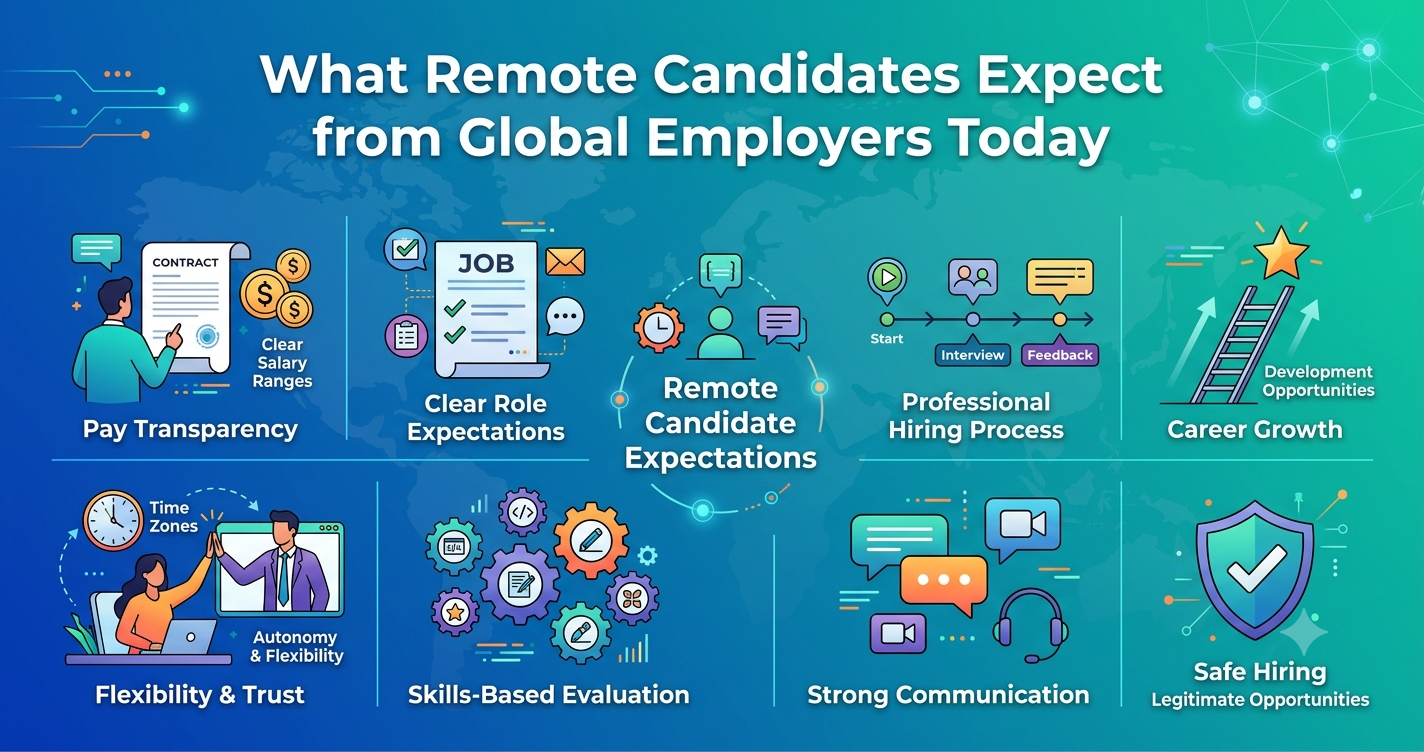
Remote Candidates expect global employers to offer transparency, trust, flexibility, fair evaluation, and modern hiring experiences that reflect the realities of remote work.
Remote work has changed the relationship between employers and job seekers. Today, professionals are no longer limited to opportunities in their local city or country. They can apply for remote job opportunities with global employers, compete for better roles, and build careers across borders. This shift has created a more competitive hiring environment where employers must do more than post a job and wait for applications. Remote Candidates now evaluate companies carefully before applying, interviewing, or accepting an offer. They want clarity, trust, fair evaluation, strong communication, and a professional hiring experience. They also want employers to understand that remote work requires different systems, expectations, and support compared to traditional office-based roles. For global employers, attracting strong remote talent means building a hiring process that respects candidate experience from the first interaction. Remote recruitment is no longer only about finding talent. It is about creating confidence on both sides. Companies that understand what Remote Candidates expect will be better positioned to attract skilled professionals, reduce hiring drop-offs, and build stronger global teams.
1. Remote Candidates Expect Clear Role Expectations
Remote Candidates want clarity before they commit time to an application or interview process. When a job description is vague, candidates may question whether the employer understands the role, the workflow, or the expectations of remote work.
Global employers should clearly explain responsibilities, working hours, communication expectations, reporting structure, required tools, and performance goals. This helps candidates decide whether the role fits their skills, lifestyle, and career goals. Clear expectations also reduce confusion after hiring and improve long-term performance. For remote roles, details such as time zone overlap, meeting frequency, and collaboration style are especially important. The more transparent the employer is from the start, the more confidence candidates have in the opportunity.
2. Remote Candidates Want Transparency About Pay and Benefits
Pay transparency is becoming one of the most important expectations in remote recruitment. Remote Candidates often apply across countries, which means compensation expectations can vary depending on location, experience, and market demand.
Global employers should provide salary ranges, payment structure, benefits, contract type, and any location-based compensation rules as early as possible. Candidates do not want to move through multiple interview stages only to discover that the offer does not match their expectations. Transparent pay information builds trust and saves time for both employers and job seekers. It also helps employers attract candidates who are genuinely aligned with the opportunity. In global hiring, compensation clarity is not only a financial issue, but also a trust-building signal.
3. Remote Candidates Expect a Professional Hiring Process
A remote hiring process is often the candidate’s first real experience with an employer. If the process feels slow, confusing, or disorganized, candidates may assume the company’s remote work culture is the same.
Remote Candidates expect clear communication, structured interview steps, realistic timelines, and timely updates. They want to know what will happen next, who they will meet, and how they will be evaluated. A professional hiring process shows that the employer respects their time and is serious about finding the right person. This is especially important when hiring across borders, where candidates may already be cautious about legitimacy and reliability. Companies that create organized hiring experiences are more likely to attract and retain high-quality remote talent.
4. Remote Candidates Want Fair and Skills-Based Evaluation
Remote Candidates want to be evaluated on their ability, communication, experience, and potential, not just on location, resume formatting, or traditional credentials. In global recruitment, talent can come from many different markets and professional backgrounds.
Employers should use structured evaluation methods that focus on skills, problem-solving, communication, and role readiness. Skills-based hiring helps reduce bias and gives strong candidates a fair opportunity to prove their value. It also helps employers avoid missing talent simply because a candidate’s background looks different from a local hiring profile. For remote work, practical ability and communication quality often matter more than where someone studied or previously worked. Fair evaluation helps global employers build stronger and more diverse teams.
5. Remote Candidates Expect Flexibility With Accountability
Flexibility is one of the biggest reasons professionals pursue remote job opportunities. However, Remote Candidates also understand that successful remote work requires accountability, discipline, and clear performance expectations.
Global employers should explain what flexibility actually means in the role. Some roles may allow fully flexible hours, while others may require set overlap with specific time zones. Candidates appreciate honesty because it helps them determine whether the role fits their daily routine and working style. Flexibility should not mean unclear expectations, and accountability should not mean constant monitoring. The strongest remote work environments balance autonomy with measurable outcomes, clear goals, and respectful communication.
6. Remote Candidates Want Trust Instead of Micromanagement
Trust is a major factor in remote work success. Remote Candidates want employers who measure performance by outcomes rather than constant activity tracking or unnecessary supervision.
Global employers should build management systems that focus on deliverables, communication, and results. Candidates are more likely to feel motivated when they are trusted to manage their time and responsibilities. Micromanagement can damage morale, reduce productivity, and make remote employees feel disconnected from the company. Trust does not mean a lack of structure. It means setting clear expectations, providing support, and allowing professionals to do their work without excessive control.
7. Remote Candidates Expect Strong Communication From Employers
Communication is the foundation of successful remote work. Remote Candidates pay close attention to how employers communicate during the hiring process because it often reflects how the company operates internally.
Employers should communicate clearly, respond within reasonable timelines, and provide helpful information at each stage. Candidates want to understand the role, the company culture, the team structure, and the decision-making process. Poor communication can create doubt, especially when candidates are dealing with global employers they have never met in person. Strong communication builds confidence and keeps candidates engaged. In remote recruitment, communication quality is one of the strongest signals of employer credibility.
8. Remote Candidates Want Opportunities for Career Growth
Remote Candidates are not only looking for flexible jobs. Many are looking for long-term career growth, stronger earning potential, and access to global opportunities that may not exist in their local market.
Global employers should explain how remote employees can grow within the company. This may include training, promotions, leadership opportunities, skill development, mentorship, or access to larger projects. Candidates are more likely to commit when they see a future beyond the initial role. Career growth is especially important for skilled professionals who want remote work to become a serious career path, not just a temporary arrangement. Employers that communicate growth opportunities clearly can attract more ambitious and committed candidates.
9. Remote Candidates Expect Modern Hiring Tools
Remote Candidates increasingly expect hiring processes to match the nature of remote work. If a company is hiring globally but uses outdated systems, long email chains, and resume-only screening, candidates may question how prepared the employer is for remote team management.
Modern remote recruitment should include structured applications, video profiles, AI candidate screening, and clear digital workflows. These tools create a smoother experience and help candidates present themselves more effectively. Video profiles are especially valuable because they allow candidates to show communication ability, confidence, and professionalism beyond a written resume. AI screening can also help employers review applications more consistently and efficiently. Modern hiring tools show candidates that the company is serious about remote work.
10. Remote Candidates Want a Safe and Legitimate Hiring Experience
Remote job seekers are often cautious because the remote job market can include unclear offers, fake opportunities, unpaid trial work, and poor communication. Trust and legitimacy matter deeply when candidates apply for global roles.
Global employers should provide clear company information, verified contact details, transparent job requirements, and professional communication throughout the process. Candidates should never feel pressured to share sensitive personal or financial information too early. Employers should also be clear about trial tasks, payment expectations, contract terms, and onboarding requirements. A safe hiring experience builds confidence and protects both sides. In global remote recruitment, trust is one of the biggest factors influencing whether strong candidates continue or withdraw.
11. Practical Tips for Global Employers Hiring Remote Candidates
Attracting strong Remote Candidates requires more than offering a remote role. Employers need to create a hiring experience that is clear, fair, modern, and built around the expectations of global talent.
1. Write remote-specific job descriptions
Employers should avoid generic job descriptions that could apply to any office role. A remote-specific job description should explain time zone requirements, communication tools, reporting structure, expected outcomes, and collaboration style. This helps candidates understand whether the opportunity matches their work preferences and availability. It also reduces unqualified applications because candidates can self-assess before applying. Clear job descriptions improve hiring efficiency and create a better first impression.
2. Communicate timelines from the beginning
Remote Candidates value hiring processes that are organized and predictable. Employers should explain how many interview stages there will be, what each stage involves, and when candidates can expect feedback. This reduces uncertainty and helps candidates stay engaged throughout the process. Clear timelines also show that the company respects candidate time and operates professionally. In a competitive remote job market, strong communication can prevent good candidates from dropping out.
3. Use video profiles to evaluate communication
Video profiles help employers understand how candidates communicate before scheduling deeper interviews. This is especially useful for remote roles where communication skills directly affect team performance. Candidates also benefit because they can show personality, confidence, and motivation beyond a traditional resume. Video-based hiring creates a more human and transparent evaluation process. It helps both sides make better decisions earlier in the hiring journey.
4. Focus on outcomes, not location
Global employers should avoid making assumptions based on where a candidate lives. Strong remote professionals can come from many countries, cities, and economic backgrounds. Instead of focusing too heavily on location, employers should evaluate skills, reliability, communication, and role alignment. This opens access to a wider talent pool and improves hiring quality. Outcome-based evaluation helps employers build stronger global teams while giving candidates a fair chance to compete.
5. Create a respectful candidate experience
Every candidate interaction shapes how people perceive the employer brand. Even candidates who are not selected may remember whether the process felt respectful, clear, and professional. Employers should provide updates, avoid unnecessary delays, and communicate decisions with care. A respectful experience builds trust and improves long-term reputation in the global talent market. Remote Candidates are more likely to recommend or reapply to companies that treat them professionally.
How Remote Recruit Supports Employers and Job Seekers
Remote Recruit helps employers and job seekers succeed in a hiring environment shaped by global talent, remote work, AI screening, and video-based evaluation. For employers, Remote Recruit provides a modern platform to connect with Remote Candidates beyond traditional resumes and outdated hiring processes. Employers can use AI candidate screening to identify relevant talent faster and video profiles to evaluate communication, professionalism, and authenticity earlier in the process.
Remote Recruit supports companies that want to build global teams with more confidence, speed, and structure. It helps reduce the limitations of resume-only screening by giving employers a richer view of candidate potential. This is especially useful when hiring remote professionals across different countries and time zones.
For job seekers, Remote Recruit creates a better way to stand out in competitive remote recruitment markets. Candidates can showcase their skills, personality, communication style, and motivation through video profiles. This helps them build trust with global employers and present themselves more professionally. By combining AI-powered screening, video-based hiring, and global remote recruitment tools, Remote Recruit creates a more transparent and effective hiring experience for both sides.
Conclusion
Remote Candidates are changing the expectations of global hiring. They are no longer simply applying for jobs and waiting for employers to decide. They are evaluating companies just as carefully as companies evaluate them. They want transparency, fair pay information, clear expectations, professional communication, flexible work models, and trustworthy hiring experiences. Employers that fail to meet these expectations may lose strong candidates before the final interview stage.
For global employers, understanding candidate expectations is no longer optional. It is part of building a competitive hiring strategy. Remote recruitment works best when employers create processes that reflect the realities of distributed work. This means using modern tools, evaluating candidates fairly, communicating clearly, and building trust from the first interaction.
Remote Recruit supports this shift by helping employers and job seekers connect through AI screening, video profiles, and structured global hiring workflows. As remote work continues to grow, the companies that win top talent will be those that understand what Remote Candidates expect and build hiring experiences that meet those expectations with confidence.
Frequently Asked Questions
What do Remote Candidates expect from global employers?
Remote Candidates expect clear job details, fair evaluation, pay transparency, flexible work expectations, strong communication, and a trustworthy hiring process.
Why is transparency important in remote recruitment?
Transparency helps candidates understand the role, compensation, expectations, and hiring process before investing time. It also builds trust between candidates and employers.
How can global employers attract better Remote Candidates?
Global employers can attract better candidates by writing clear job descriptions, communicating professionally, using modern hiring tools, and offering fair evaluation processes.
Why do Remote Candidates value video profiles?
Video profiles allow candidates to show communication ability, confidence, and personality beyond a written resume. This helps them stand out in global remote recruitment.
What role does AI screening play in remote recruitment?
AI screening helps employers review candidates more efficiently, identify stronger matches, and create a more consistent evaluation process across global applicant pools.
How does Remote Recruit help Remote Candidates?
Remote Recruit helps Remote Candidates showcase their skills and communication ability through video profiles while connecting them with global employers looking for remote talent.
Sign up on Remote Recruit today to connect with global opportunities, discover remote talent, and build better hiring experiences for the future of work.