Global Remote Recruitment requires structure, visibility, and intelligent screening to reduce risk and improve hiring outcomes. Remote Recruit empowers employers to build trusted global teams with confidence and clarity.
Global Remote Recruitment has shifted from a temporary solution to a permanent strategy for growth-focused companies. Organizations now recruit across borders to access specialized skills, reduce costs, and build resilient distributed teams. While the opportunity is significant, so are the risks. Employers face challenges such as misrepresented experience, communication gaps, inconsistent evaluation standards, and cultural misalignment. Research shows that a single poor hiring decision can cost up to thirty percent of the employee’s annual salary when factoring in lost productivity and replacement costs.
In a global hiring environment, these risks increase due to limited in-person interaction and high application volumes. Companies that succeed with Global Remote Recruitment do not rely on intuition alone. They implement structured systems, consistent screening, and technology-enabled evaluation to improve decision-making. By focusing on transparency, communication readiness, and measurable performance criteria, employers can reduce hiring risk and build stronger global teams. The following strategies highlight how businesses can improve outcomes while maintaining speed, fairness, and scalability in global recruitment.
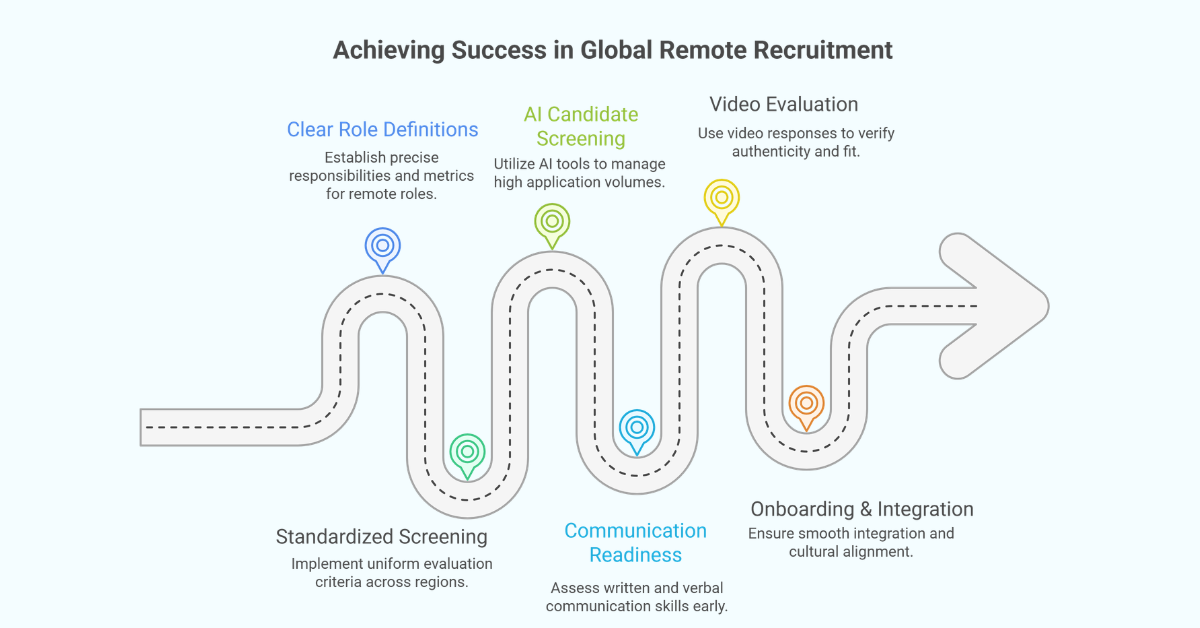
1. Establish Clear Role Definitions and Performance Metrics
Clarity is the foundation of successful Global Remote Recruitment. Without precise role expectations, remote employees may struggle to align with business goals.
When employers define specific responsibilities, deliverables, reporting structures, and success indicators, candidates understand what is required from the beginning. Clear job descriptions attract candidates who are genuinely aligned with the role and discourage misaligned applicants. Performance metrics create accountability and reduce ambiguity once hiring is complete. This clarity improves onboarding efficiency and long-term productivity. Companies that invest in structured role definition consistently experience lower turnover and stronger performance in global teams.
2. Standardize Screening Processes Across Regions
Inconsistent evaluation criteria can introduce bias and reduce hiring quality. Global Remote Recruitment demands uniform screening standards regardless of geography.
Applying standardized screening criteria ensures every candidate is evaluated based on skills, experience, and communication ability rather than assumptions tied to location. Structured evaluation forms, defined interview questions, and consistent scoring frameworks improve objectivity. Standardization enhances fairness and strengthens internal alignment among hiring teams. It also allows companies to compare candidates accurately across global talent pools. Consistency is critical for building trust in distributed hiring decisions.
3. Integrate AI Candidate Screening to Reduce Risk
High application volumes in global recruitment can overwhelm hiring teams. AI Candidate Screening helps manage scale while maintaining quality.
AI tools analyze resumes, application responses, and behavioral indicators to identify alignment with job requirements. They detect inconsistencies, highlight relevant experience, and flag potential red flags early in the process. This reduces reliance on manual screening and speeds up decision-making. By automating repetitive tasks, recruiters can focus on strategic evaluation and interviews. Integrating AI Candidate Screening improves accuracy and significantly lowers the risk of advancing unqualified candidates.
4. Evaluate Communication Readiness Early
Communication is one of the strongest predictors of success in remote roles. Yet many hiring processes evaluate it too late.
Global Remote Recruitment should include early assessment of written and verbal communication ability. Employers must ensure candidates can express ideas clearly, respond professionally, and collaborate across time zones. Early communication screening prevents misunderstandings and productivity issues after hiring. It also supports smoother onboarding and faster team integration. Prioritizing communication readiness improves long-term performance in distributed teams.
5. Use Video-Based Evaluation for Authenticity and Fit
Resumes alone cannot verify authenticity or assess cultural alignment. Video-based evaluation adds essential human context to global recruitment.
Through structured video responses, employers can observe confidence, clarity, and alignment with company values. This approach reduces the risk of misrepresentation and proxy interviews. Video also provides insight into professionalism and motivation. By incorporating video early in Global Remote Recruitment, employers build greater confidence in hiring decisions. Authentic evaluation improves both short-term hiring accuracy and long-term team cohesion.
6. Strengthen Onboarding and Cultural Integration
Mitigating risk does not end with hiring. Effective onboarding is critical for improving outcomes in Global Remote Recruitment.
Structured onboarding programs should introduce company values, communication norms, and workflow systems clearly. Regular check-ins during early months ensure alignment and address potential issues quickly. Cultural integration efforts foster collaboration and engagement within distributed teams. Investing in onboarding reduces early attrition and enhances employee satisfaction. Companies that prioritize integration see higher productivity and retention rates in global hires.
How Remote Recruit Improves Outcomes in Global Remote Recruitment
Remote Recruit is designed to address the core risks associated with Global Remote Recruitment by combining structured evaluation with advanced technology. For employers, the platform integrates AI Candidate Screening with video-based hiring to create a consistent and transparent recruitment experience. Employers can verify candidate authenticity, evaluate communication skills, and assess cultural alignment before interviews begin. This reduces uncertainty and accelerates confident decision-making.
Remote Recruit operates as a purpose-built remote hiring platform tailored for global talent acquisition. It standardizes evaluation across regions and supports scalable offshore recruitment without sacrificing quality. Employers gain access to verified global talent pools and structured workflows that reduce hiring friction.
For job seekers, Remote Recruit provides a fair and equitable pathway to international opportunities. Candidates are evaluated based on skills, communication ability, and effort rather than geography. Video introductions allow professionals to showcase their strengths authentically. By verifying both employers and candidates, Remote Recruit builds trust on both sides and supports sustainable global hiring outcomes.
Conclusion
Global Remote Recruitment offers unmatched access to talent and flexibility, but success depends on disciplined execution. Employers who fail to implement structured screening and standardized evaluation expose themselves to unnecessary risk. By defining clear expectations, integrating AI Candidate Screening, evaluating communication readiness, and leveraging video-based hiring, organizations can significantly improve recruitment outcomes.
Modern recruitment demands both speed and precision. Companies that combine technology with thoughtful human evaluation create competitive advantage in global hiring markets. Platforms like Remote Recruit demonstrate how intelligent systems can enhance transparency, reduce bias, and improve performance. When organizations approach Global Remote Recruitment strategically, they unlock global talent while minimizing hiring mistakes. The result is a stronger, more resilient workforce capable of driving sustained business growth.
Frequently Asked Questions
What is Global Remote Recruitment?
Global Remote Recruitment refers to hiring employees across international borders to work remotely as part of a distributed workforce.
Why is risk higher in Global Remote Recruitment?
Risk increases due to limited in-person interaction, high application volumes, and cross-cultural communication challenges.
How can companies reduce risk in Global Remote Recruitment?
Companies can reduce risk by standardizing screening processes, integrating AI Candidate Screening, and using video-based evaluation.
Is AI important for Global Remote Recruitment?
Yes. AI Candidate Screening improves consistency, speeds up evaluation, and helps detect potential issues early.
How does Remote Recruit support Global Remote Recruitment?
Remote Recruit combines AI screening, video evaluation, and structured workflows to deliver secure and effective global hiring.