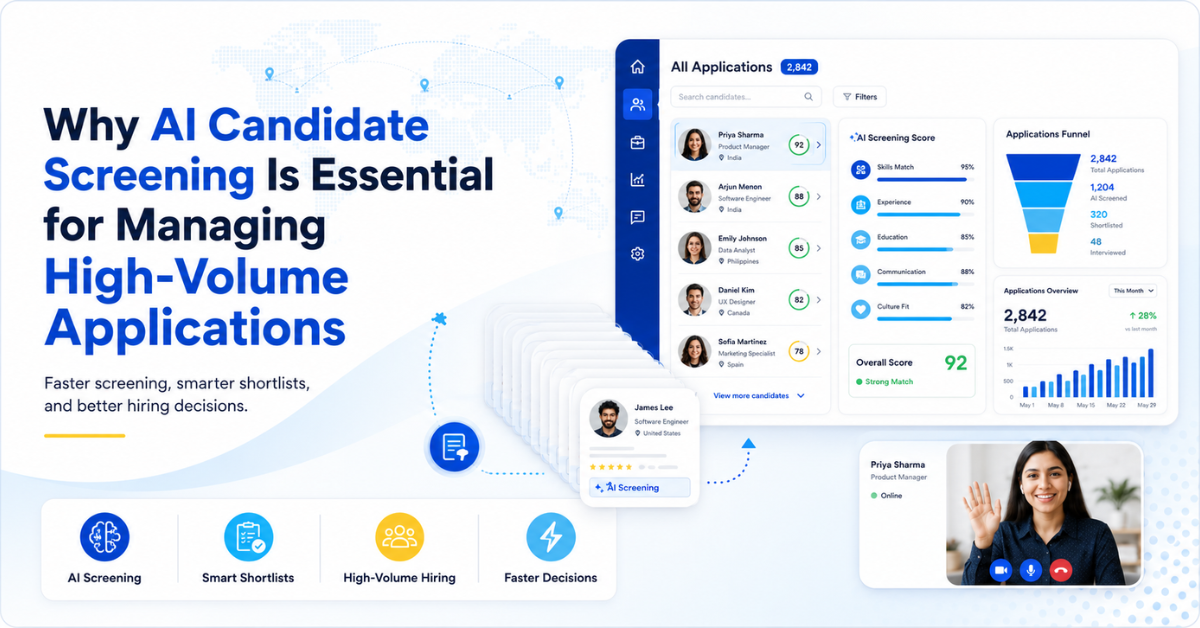
Automated Candidate Screening helps employers manage high-volume applications with more speed, structure, and confidence while improving the quality of candidate shortlisting.
High-volume hiring can quickly become overwhelming for employers. A single remote job opening can attract hundreds of applications from candidates across different cities, countries, time zones, and experience levels. While this gives employers access to a larger talent pool, it also creates a serious screening challenge. Hiring teams must review resumes, compare skills, assess role fit, communicate with candidates, and move quickly before strong applicants accept other offers.
Automated Candidate Screening is becoming essential because traditional manual screening is no longer enough for modern recruitment. Recruiters need a faster and more structured way to identify suitable candidates without missing strong profiles. AI candidate screening can help organize application data, compare candidate profiles against job requirements, and support smarter shortlisting decisions.
This is especially important for remote and global hiring, where employers may receive applications from many locations. The World Economic Forum’s Future of Jobs Report 2025 states that employers expect 39% of workers’ existing skill sets to be transformed or become outdated between 2025 and 2030, which means hiring teams need better ways to evaluate skills and adaptability. SHRM also reported that 43% of organizations used AI in HR tasks in 2025, up from 26% in 2024.
1. Why High-Volume Applications Are Difficult to Manage
High-volume applications can create both opportunity and pressure for employers. More applicants can mean a stronger chance of finding the right person, but only if the hiring process can manage the volume properly. Without Automated Candidate Screening, recruiters may spend too much time reviewing unsuitable applications and too little time engaging qualified candidates.
1.1. Too many applications can slow down hiring
When a job receives hundreds of applications, recruiters may struggle to review every profile quickly. This can create delays in shortlisting, interviews, and final decisions. Strong candidates may lose interest if they do not hear back within a reasonable time. Automated Candidate Screening helps employers process applications faster so qualified candidates can move forward before the hiring pipeline becomes too slow.
1.2. Manual resume review increases recruiter workload
Manual screening requires recruiters to read resumes, check experience, compare skills, and decide who should move to the next stage. This becomes difficult when applications come from different industries, countries, and career backgrounds. Recruiters may spend hours on repetitive screening tasks instead of focusing on candidate engagement and hiring manager alignment. AI candidate screening reduces this workload by helping organize and prioritize applications more efficiently.
1.3. Strong candidates can be missed
When recruiters are overloaded, there is a higher risk of missing good candidates. A strong profile may be overlooked because the resume format is different, the job title is unfamiliar, or the application appears late in the review process. Automated Candidate Screening can help reduce this risk by applying structured criteria across applications. This allows employers to identify relevant skills and role fit more consistently.
1.4. Hiring teams may struggle to compare candidates fairly
High-volume applications often include candidates with different experience levels, locations, qualifications, and salary expectations. Comparing them manually can become inconsistent, especially when several recruiters or hiring managers are involved. Candidate shortlisting software can help standardize the review process and make comparison easier. This supports better hiring decisions because candidates are evaluated against clearer role requirements.
2. What Automated Candidate Screening Means
Automated Candidate Screening is the use of technology to help employers review, organize, and prioritize job applications. It does not mean removing human judgment from hiring. Instead, it supports recruiters by reducing repetitive work and helping them focus on the most relevant candidates.
2.1. It reviews candidate data against job requirements
Automated screening tools can compare candidate information with the requirements of a job role. This may include skills, experience, job titles, education, certifications, location, availability, and keywords connected to the position. The goal is to help recruiters identify candidates who appear to match the role more closely. This makes the first stage of screening faster and more structured.
2.2. It helps rank and organize applications
When applications arrive in large numbers, recruiters need a clear way to organize them. Automated Candidate Screening can help group candidates based on relevance, completeness, role fit, or screening criteria. This does not mean the highest-ranked candidate is automatically the best hire. It simply gives recruiters a more practical starting point for review and shortlisting.
2.3. It supports faster shortlisting
Shortlisting is often one of the slowest parts of high-volume hiring. AI candidate screening helps hiring teams move faster by identifying candidates who meet the most important requirements. Recruiters can then review a more focused group of applicants instead of starting with every resume manually. This improves speed while still keeping humans involved in final decisions.
2.4. It improves hiring consistency
Different recruiters may interpret resumes differently, especially when under pressure. Automated Candidate Screening helps create a more consistent process by applying the same screening logic across applications. This is useful when employers are hiring across multiple roles, locations, or departments. Consistency helps reduce confusion and supports more reliable hiring outcomes.
3. Why AI Candidate Screening Is Essential for High-Volume Hiring
AI candidate screening has become important because application volume is rising across many remote and digital roles. Employers need a process that can scale without sacrificing quality. Automated Candidate Screening helps companies manage large applicant pools while improving speed, visibility, and decision-making.
3.1. It reduces repetitive manual work
Recruiters often spend too much time checking whether candidates meet basic requirements. This includes reviewing experience, searching for skills, checking location preferences, and filtering incomplete applications. Automated Candidate Screening reduces repetitive work by helping identify candidates who are more likely to fit the role. This allows recruiters to focus on meaningful conversations, interviews, and candidate relationships.
3.2. It helps recruiters act faster
Speed matters in high-volume hiring because strong candidates may be applying to many roles at the same time. If employers delay screening, they may lose qualified talent to faster-moving companies. AI candidate screening helps recruiters review applications quickly and build shortlists sooner. SHRM found that nearly 9 in 10 HR professionals whose organizations use AI for recruiting say it saves time or increases efficiency.
3.3. It improves shortlist quality
A better shortlist helps hiring managers spend time with candidates who are more likely to fit the role. Automated Candidate Screening can support this by identifying the skills, experience, and profile details that matter most. It helps reduce the number of unsuitable candidates moving into interviews. Better shortlists save time and improve the quality of hiring discussions.
3.4. It helps hiring teams scale
A manual screening process may work for one role, but it becomes difficult when companies are hiring for several positions at once. Automated Candidate Screening helps employers manage multiple roles and large applicant pools more efficiently. This is especially useful for companies hiring remote talent, offshore teams, customer support representatives, sales roles, or digital professionals. A scalable process allows hiring teams to grow without becoming overwhelmed.
4. Key Problems Automated Candidate Screening Solves
High-volume hiring creates several problems that can affect speed, quality, and candidate experience. Automated Candidate Screening helps solve these issues by creating a more structured recruitment process. When used properly, it improves both recruiter productivity and employer confidence.
4.1. Slow application review
Slow application review is one of the biggest problems in high-volume hiring. When recruiters need to manually check every resume, the process can take days or even weeks. This delay can damage candidate interest and reduce the employer’s ability to compete for top talent. Automated Candidate Screening helps speed up review by organizing candidate information and highlighting stronger matches earlier.
4.2. Inconsistent screening standards
Inconsistent screening can happen when different recruiters apply different judgment to the same role. One recruiter may prioritize years of experience while another may focus more on specific tools or industry background. This creates confusion and can lead to uneven shortlists. AI candidate screening helps apply clearer criteria across applicants so the review process becomes more consistent.
4.3. Poor candidate communication
When recruiters are overwhelmed, candidate communication often suffers. Applicants may wait too long for updates or receive no response at all. This can harm the employer brand and discourage strong candidates from applying again in the future. A remote hiring platform with automated screening and candidate workflow tools can help employers manage updates more efficiently.
4.4. Interview overload
Without proper screening, hiring managers may end up interviewing too many candidates who are not the right fit. This wastes time and can lead to slower decisions. Automated Candidate Screening helps reduce interview overload by narrowing the pool before live interviews. This allows hiring managers to focus on candidates who already meet important role criteria.
5. Important Features to Look for in Candidate Shortlisting Software
Not all screening tools offer the same level of value. Employers should look for candidate shortlisting software that supports real hiring needs, not just basic automation. The best solutions should improve speed, quality, collaboration, and candidate experience.
5.1. Skills-based screening
Skills-based screening helps employers identify candidates who match the actual requirements of the job. This is more useful than relying only on job titles because titles can vary across countries and industries. The software should help recruiters understand whether candidates have relevant capabilities, tools, experience, and practical knowledge. Skills-based screening is especially useful for remote hiring because employers may be comparing talent from many different markets.
5.2. Role-specific criteria
Every role has different requirements, so the screening process should not be generic. A customer support role may require communication skills, time zone coverage, and CRM experience, while a developer role may require specific programming languages and project experience. Candidate shortlisting software should allow employers to define role-specific criteria clearly. This improves the relevance of screening results and helps recruiters create better shortlists.
5.3. Clear candidate summaries
Recruiters and hiring managers need candidate information that is easy to review. Clear summaries can highlight skills, experience, availability, location, salary expectations, and screening insights. This saves time because teams do not need to search through long resumes for every detail. A strong summary helps hiring teams make faster and more informed decisions.
5.4. Easy collaboration for hiring teams
Recruitment decisions often involve several people, including recruiters, hiring managers, department heads, and leadership teams. Candidate shortlisting software should make it easy for these stakeholders to review profiles, add notes, share feedback, and track decisions. This reduces scattered communication across emails and spreadsheets. Better collaboration helps prevent delays and keeps everyone aligned on hiring priorities.
6. How Automated Candidate Screening Improves Remote Hiring
Remote hiring adds another layer of complexity because employers often evaluate candidates they may never meet in person. Automated Candidate Screening helps employers assess remote talent more efficiently by combining structured data, AI screening, and role fit signals. This is useful for companies hiring across countries, time zones, and distributed teams.
6.1. It helps assess remote work readiness
Remote work requires independence, communication, accountability, and comfort with digital tools. Automated Candidate Screening can help employers identify whether candidates have experience working remotely or using remote collaboration tools. This may include platforms for video meetings, project management, CRM, reporting, or team communication. Screening for remote readiness helps reduce the risk of hiring candidates who may struggle in a distributed work environment.
6.2. It supports global talent comparison
When employers hire remotely, they may receive applications from many countries and regions. Candidate experience, job titles, and salary expectations can vary widely across markets. Automated Candidate Screening helps structure this information so employers can compare candidates more fairly. This supports better decision-making when building global remote teams.
6.3. It improves time zone and availability matching
Time zone alignment is important for remote teams, especially for roles that require meetings, customer support coverage, or collaboration with specific departments. Automated screening can help employers identify candidates whose availability fits the role. This reduces wasted interviews with candidates who cannot meet schedule expectations. Better availability matching improves both hiring efficiency and long-term team performance.
6.4. It works well with video-based hiring
Automated Candidate Screening becomes even stronger when combined with video-based hiring. AI can help identify relevant candidates, while video profiles help employers evaluate communication, confidence, and professionalism. This gives hiring teams both structured data and human insight before interviews. For remote roles, this combination improves shortlisting quality and reduces uncertainty.
7. Benefits of Automated Candidate Screening for Employers
Employers need recruitment processes that are fast, fair, and scalable. Automated Candidate Screening supports these goals by helping hiring teams manage high-volume applications without losing control of quality. It also makes hiring operations more predictable and easier to improve over time.
7.1. Faster shortlisting
Automated Candidate Screening helps recruiters move from application volume to relevant shortlists faster. Instead of manually reviewing every resume from the beginning, recruiters can focus on candidates who match key criteria. This reduces delays and helps employers respond to strong applicants more quickly. Faster shortlisting is especially important when hiring remote talent in competitive markets.
7.2. Better recruiter productivity
Recruiters add the most value when they engage candidates, understand hiring manager needs, and support final decisions. If they spend most of their time on repetitive resume review, productivity suffers. Automated screening allows recruiters to spend more time on strategic hiring work. This improves both team efficiency and candidate engagement.
7.3. Improved hiring manager experience
Hiring managers want strong, relevant shortlists, not large numbers of unqualified candidates. Automated Candidate Screening helps recruiters deliver candidates who better match the role requirements. This makes interview time more productive and reduces frustration for hiring managers. When shortlists improve, hiring managers are more likely to trust the recruitment process.
7.4. Stronger hiring decisions
Good hiring decisions depend on clear information. Automated Candidate Screening helps organize candidate data so employers can evaluate skills, experience, availability, and fit more effectively. It reduces reliance on guesswork and supports more structured comparisons. This helps employers make decisions with more confidence and less confusion.
8. Benefits of Automated Candidate Screening for Job Seekers
Automated Candidate Screening can also improve the experience for job seekers when it is used responsibly. Candidates benefit from faster review, clearer matching, and better visibility when their profiles are complete and relevant. The key is to use automation to support fairness and efficiency rather than create a cold or confusing process.
8.1. Faster application review
Job seekers often feel frustrated when they apply and hear nothing for weeks. Automated screening can help employers review applications sooner and move qualified candidates forward faster. This creates a better experience because candidates are not left waiting without clarity. Faster review also helps candidates understand whether they should prepare for the next stage.
8.2. Better matching to suitable roles
Candidates are more likely to succeed when they are matched to roles that fit their skills and availability. Automated Candidate Screening can help employers identify where a candidate’s profile aligns with the job requirements. This improves the chance of relevant hiring conversations. Better matching benefits both employers and candidates because it reduces wasted time on poor-fit opportunities.
8.3. More visibility for complete profiles
Candidates with detailed profiles can benefit from automated screening because their skills, experience, and preferences are easier to identify. A complete profile gives screening tools and recruiters more useful information to review. This can improve visibility when employers are searching for specific skills or remote work experience. Job seekers should keep their profiles updated to increase their chances of being discovered.
8.4. More structured hiring journeys
A structured process helps candidates understand what happens after they apply. When employers use a remote hiring platform with screening workflows, candidates may receive clearer next steps and better communication. This reduces confusion and creates a more professional experience. Candidates are more likely to stay engaged when the hiring journey feels organized.
9. How Remote Recruit Helps Employers and Job Seekers
Remote Recruit supports employers and job seekers with a modern remote hiring platform designed to make global recruitment faster, clearer, and more effective. For employers, Remote Recruit helps connect businesses with skilled remote candidates across different roles, regions, and experience levels. Employers can review candidate profiles, assess skills, evaluate availability, and use AI-supported screening to improve shortlisting. Video profiles can also help hiring teams understand communication style, confidence, and remote work readiness before scheduling interviews.
For job seekers, Remote Recruit creates a better way to stand out in a competitive remote job market. Candidates can build complete profiles that highlight skills, work experience, availability, preferred roles, and career goals. Video-based features allow candidates to show their communication ability and personality beyond the resume. This is especially valuable when applying to global employers who need more confidence before moving forward. Remote Recruit helps reduce friction for both sides by improving discovery, screening, and visibility. Employers get a more structured way to manage candidate volume, while job seekers get more opportunities to be seen by companies hiring remote talent.
10. Best Practices for Using Automated Candidate Screening
Automated Candidate Screening works best when employers use it thoughtfully. It should support human decision-making, improve consistency, and create a better hiring experience. The goal is not to remove people from recruitment, but to help hiring teams make better use of their time.
10.1. Define screening criteria before applications arrive
Employers should clearly define what they are looking for before opening a role. This includes required skills, preferred experience, location flexibility, time zone needs, salary range, and remote work expectations. Clear criteria help automated screening tools produce more relevant results. Without clear criteria, even the best software may generate weak or confusing shortlists.
10.2. Use automation to support, not replace, human review
Automation should help recruiters work faster, but final hiring decisions should still involve people. Human judgment is important for understanding context, motivation, communication style, and growth potential. Recruiters should review automated results carefully and use them as a guide rather than a final decision. This creates a more balanced and responsible screening process.
10.3. Keep the candidate experience simple
A screening process should not make candidates complete too many unnecessary steps. Long forms, repeated questions, and unclear requirements can reduce application completion rates. Employers should only ask for information that helps make better hiring decisions. A simple and respectful process helps attract stronger candidates and improves employer reputation.
10.4. Review screening performance regularly
Employers should monitor whether their automated screening process is producing strong shortlists. This includes looking at interview quality, hiring manager feedback, candidate response rates, and final hiring outcomes. If good candidates are being missed or unsuitable candidates are moving forward, the criteria may need adjustment. Regular review helps keep Automated Candidate Screening accurate and useful over time.
11. Common Mistakes Employers Should Avoid
Automated Candidate Screening can improve recruitment, but it must be used carefully. Mistakes can reduce fairness, weaken candidate experience, or create overreliance on technology. Employers should avoid these common problems when managing high-volume applications.
11.1. Depending only on keyword matching
Keyword matching can be helpful, but it should not be the only screening method. Strong candidates may use different terms to describe similar skills or experience. If employers rely too heavily on exact keywords, they may miss qualified applicants. A better approach is to combine keywords with skills, experience, profile quality, and human review.
11.2. Ignoring transferable skills
Some candidates may not have the exact job title listed in the job description, but they may still have relevant experience. Transferable skills are especially important in remote hiring because candidates may come from different industries or markets. Automated screening criteria should allow room for related experience and practical ability. This helps employers avoid rejecting candidates who could perform well with minimal training.
11.3. Making the process feel impersonal
Candidates still want to feel respected, even when technology is used in hiring. If the process feels cold, unclear, or overly automated, strong candidates may lose interest. Employers should combine automated screening with timely communication and clear next steps. A human-centered process improves trust and candidate engagement.
11.4. Failing to align recruiters and hiring managers
Automated screening works best when recruiters and hiring managers agree on what matters most. If the hiring manager wants one type of candidate and the recruiter sets different screening criteria, the shortlist will not be effective. Teams should align on role requirements before using automation. This improves shortlist quality and reduces wasted interview time.
12. How Automated Candidate Screening Supports the Employer Buyer Journey
Employers usually move through a clear journey before choosing a hiring solution. They first recognize the problem, then compare possible tools, and finally decide which platform can help them hire better. Automated Candidate Screening supports each stage by solving the pain points of high-volume applications.
12.1. Awareness stage: Recognizing screening overload
At the awareness stage, employers realize that manual screening is slowing down hiring. Recruiters may be overwhelmed, hiring managers may be waiting too long for shortlists, and candidates may be losing interest. Automated Candidate Screening helps employers understand that high-volume applications need a structured solution. It turns a messy hiring problem into a process that can be organized and improved.
12.2. Consideration stage: Comparing better hiring tools
At the consideration stage, employers begin looking for software that can support faster and better screening. They may compare features such as AI candidate screening, video profiles, candidate summaries, dashboards, and collaboration tools. A strong remote hiring platform should show how it improves speed and quality together. Employers should focus on practical value rather than choosing technology only because it sounds advanced.
12.3. Decision stage: Choosing a scalable solution
At the decision stage, employers want confidence that the platform can support current and future hiring needs. Automated Candidate Screening is valuable because it can manage high-volume applications while improving recruiter efficiency. It also supports a repeatable process for future roles. This makes it useful for companies that expect ongoing hiring across remote, offshore, or global teams.
12.4. Growth stage: Building a stronger hiring engine
Once employers start using Automated Candidate Screening effectively, they can improve hiring over time. They can track which criteria lead to better interviews, which roles attract the most applicants, and where delays happen in the funnel. This helps companies turn recruitment into a more predictable growth function. A stronger hiring engine supports business expansion and long-term workforce planning.
13. The Future of Automated Candidate Screening
Automated Candidate Screening will continue to become more important as companies hire across larger and more competitive talent markets. Employers will need tools that help them understand skills, communication, adaptability, and remote readiness faster. The future of screening will be shaped by responsible AI, better candidate data, and stronger human oversight.
13.1. Screening will become more skills-focused
Future screening will likely place more emphasis on skills and practical ability rather than job titles alone. This is important because job titles vary across industries and countries. Employers will need better ways to understand what candidates can actually do. Skills-focused screening can help companies discover strong talent that traditional resume review might miss.
13.2. Video and screening data will work together
Automated Candidate Screening will become more powerful when combined with video-based hiring. Screening data can help identify potential matches, while video profiles can show communication, confidence, and professionalism. This creates a more complete view of candidates before interviews. Employers hiring remote talent will benefit from both structured data and human insight.
13.3. Responsible AI will become more important
As AI becomes more common in hiring, employers will need to use it responsibly. This means keeping humans involved, reviewing screening criteria, protecting candidate experience, and avoiding blind reliance on automated outputs. Responsible AI should improve fairness, speed, and decision quality. Companies that use automation carefully will build more trust with both candidates and hiring teams.
13.4. Candidate experience will influence hiring success
The best candidates will prefer employers that communicate clearly and move efficiently. Automated Candidate Screening can support this by helping employers respond faster and manage applications more professionally. However, technology must be paired with respectful communication and transparent processes. A better candidate experience can become a competitive advantage in global remote hiring.
14. Frequently Asked Questions About Automated Candidate Screening
1. What is Automated Candidate Screening?
Automated Candidate Screening is the use of technology to help employers review, organize, and prioritize job applications. It compares candidate information with job requirements and helps recruiters identify stronger matches faster. It is especially useful when employers receive high-volume applications for remote or global roles. The goal is not to replace recruiters, but to make screening more efficient and structured.
2. Why is Automated Candidate Screening important for high-volume applications?
High-volume applications can overwhelm recruiters and slow down hiring decisions. Automated Candidate Screening helps employers manage large applicant pools by organizing profiles, identifying relevant candidates, and reducing repetitive manual review. This helps recruiters respond faster and build better shortlists. It also reduces the risk of missing qualified candidates because of application overload.
3. How does AI candidate screening work?
AI candidate screening reviews candidate data such as skills, experience, qualifications, keywords, location, availability, and profile details. It compares this information with the role requirements and helps recruiters prioritize applications. The system may create candidate summaries, match signals, or shortlist recommendations. Human recruiters should still review the results and make final decisions.
4. Can Automated Candidate Screening improve hiring quality?
Yes, Automated Candidate Screening can improve hiring quality when it is used with clear criteria and human review. It helps recruiters focus on candidates who better match the role instead of spending time on unsuitable applications. It also improves consistency by applying the same screening logic across applicants. Better shortlists usually lead to better interviews and stronger hiring decisions.
5. Is Automated Candidate Screening useful for remote hiring?
Automated Candidate Screening is very useful for remote hiring because remote roles often attract applicants from many locations. Employers need to compare skills, experience, time zone fit, availability, and remote work readiness. Screening tools help structure this information and make it easier to identify suitable candidates. When combined with video profiles, it can give employers a stronger view of communication and remote readiness.
6. Does Automated Candidate Screening replace recruiters?
No, Automated Candidate Screening should not replace recruiters. It supports recruiters by reducing repetitive work and helping them review applications more efficiently. Recruiters are still needed to understand context, communicate with candidates, assess motivation, and guide hiring managers. The best results come when automation and human judgment work together.
7. What should employers look for in candidate shortlisting software?
Employers should look for skills-based screening, role-specific criteria, clear candidate summaries, collaboration tools, reporting, and a simple candidate experience. The software should help improve both speed and quality. It should also support remote hiring needs such as time zone fit, video profiles, and global talent comparison. A good platform should make hiring easier, not more complicated.
8. How does Remote Recruit help with Automated Candidate Screening?
Remote Recruit helps employers manage remote hiring with stronger candidate profiles, AI-supported screening, and video-based features. Employers can review skills, experience, availability, communication style, and remote readiness before moving candidates to interviews. Job seekers can create complete profiles and showcase their strengths to global employers. This helps both sides connect faster and with more confidence.
Conclusion
Automated Candidate Screening is no longer just a helpful feature for recruitment teams. It has become essential for employers managing high-volume applications, especially in remote and global hiring. When hundreds of candidates apply for a role, manual screening can slow down decisions, increase recruiter workload, and make it harder to identify the best talent. A structured screening process helps employers move faster while improving the quality of shortlists.
AI candidate screening, candidate shortlisting software, video-based hiring, and remote hiring platforms work together to create a more effective hiring process. Employers can reduce repetitive work, improve consistency, compare candidates more clearly, and focus interviews on stronger applicants. Job seekers also benefit when their profiles are reviewed faster and matched to more relevant opportunities.
The future of hiring will reward companies that combine smart technology with human judgment. Automated Candidate Screening should support better decisions, not replace thoughtful recruitment. Employers that use it responsibly can build stronger hiring pipelines, improve candidate experience, and secure qualified remote talent faster. Sign up on Remote Recruit today to discover skilled remote candidates, improve your screening process, and connect with talent that fits your hiring needs.