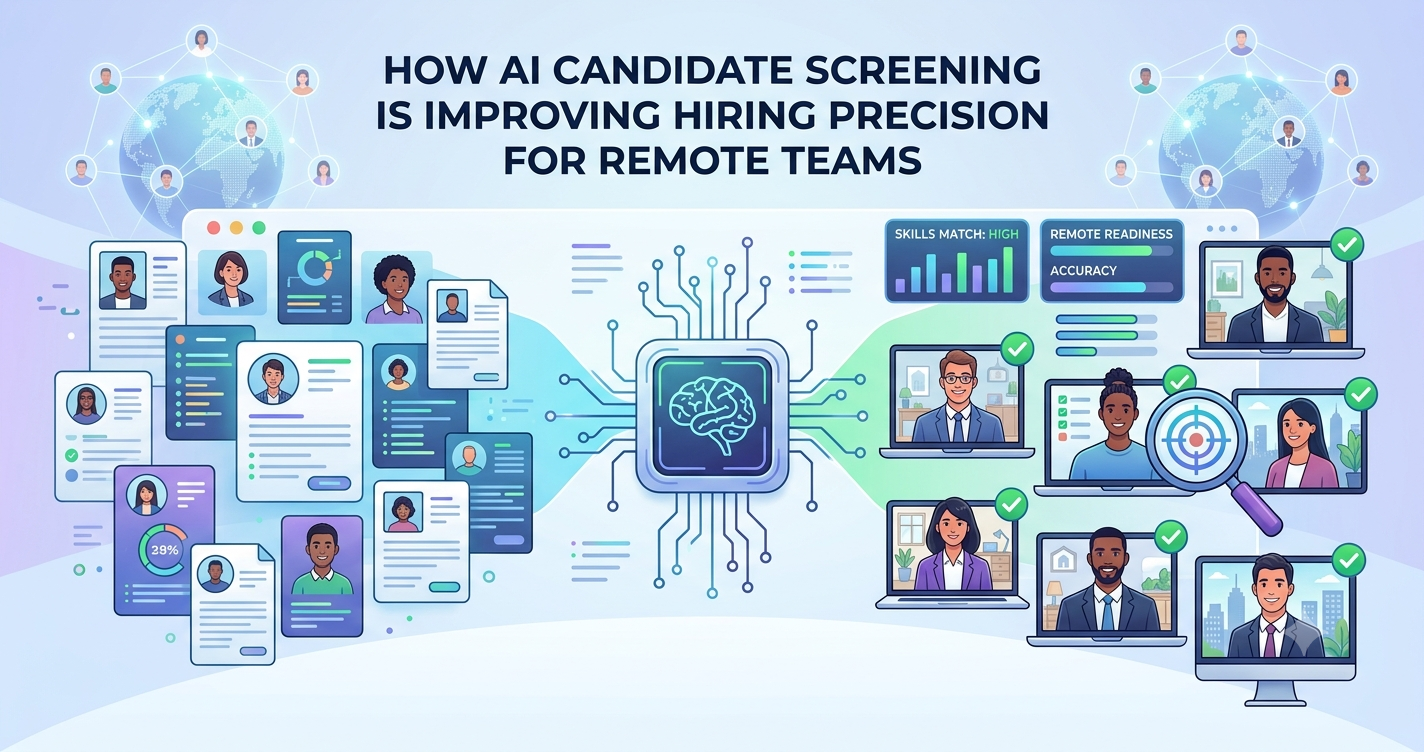
AI Candidate Screening is helping employers improve hiring precision by identifying stronger remote candidates faster, reducing screening gaps, and creating a more consistent way to evaluate global talent.
Remote hiring has created a major opportunity for companies to access skilled professionals across the world, but it has also made candidate evaluation more complex. Employers are no longer limited to local applicants, which means every open role can attract a wider and more diverse talent pool. While this is a major advantage, it also creates new challenges around screening, verification, communication, and consistency. Traditional resume reviews and manual shortlisting methods are often too slow and subjective for modern remote recruitment. Employers need a smarter way to identify candidates who are not only qualified on paper but also capable of succeeding in distributed teams. AI Candidate Screening is helping solve this challenge by bringing structure, speed, and precision into the hiring process. It supports better decision-making by analyzing candidate data, identifying relevant skills, detecting inconsistencies, and reducing repetitive manual work. For remote teams, where trust, communication, and accuracy matter deeply, AI Candidate Screening is becoming an essential part of building stronger hiring outcomes.
1. Why Hiring Precision Matters More in Remote Teams
Hiring precision is important in every recruitment process, but it becomes even more critical when hiring remote employees. Remote teams depend on communication, independence, accountability, and strong alignment with company goals.
When a remote hire is not properly matched to the role, the impact can be significant. Poor fit can lead to slower collaboration, missed deadlines, communication breakdowns, and additional management effort. Unlike office-based teams, remote managers cannot rely on daily in-person interaction to quickly identify and correct performance issues. This makes the quality of the hiring decision even more important from the beginning. AI Candidate Screening helps employers improve precision by identifying the candidates most closely aligned with role requirements, communication expectations, and remote work readiness.
2. How AI Candidate Screening Improves Early Candidate Evaluation
Early screening is one of the most important stages in remote recruitment because it shapes the entire hiring funnel. If the wrong candidates move forward, hiring teams waste time and may overlook stronger applicants.
AI Candidate Screening helps improve early evaluation by analyzing applications more consistently and efficiently than manual review alone. It can identify relevant skills, experience patterns, role alignment, and potential gaps across large candidate pools. This helps employers avoid relying only on keyword matching or quick resume scanning. Instead of manually sorting through hundreds of applications, hiring teams can focus on candidates with stronger potential. This creates a more accurate shortlist and improves the quality of every later stage in the hiring process.
3. Reducing Bias in Remote Recruitment
Bias can enter hiring decisions even when employers are trying to be fair. In remote recruitment, this can happen through assumptions about location, education background, work history, communication style, or resume formatting.
AI Candidate Screening can help reduce bias by applying the same evaluation criteria across all candidates. When configured properly, AI recruitment software focuses on role-relevant skills, experience, and qualification signals rather than subjective first impressions. This supports a more consistent and structured evaluation process. It also gives qualified candidates from different regions a better chance to be considered based on merit. For employers building global remote teams, reducing bias helps improve diversity, fairness, and access to stronger talent pools.
4. Managing High Application Volumes Without Losing Quality
Remote jobs often attract a much higher volume of applications because they are not limited by geography. This gives employers more choice, but it also makes manual screening harder and slower.
AI Candidate Screening allows hiring teams to manage large applicant volumes without sacrificing quality. It can quickly organize candidate data, highlight the strongest matches, and reduce time spent reviewing unsuitable applications. This is especially valuable for companies hiring across multiple regions or scaling remote teams quickly. Manual screening can lead to fatigue, inconsistent decisions, and missed talent when application numbers are high. AI powered screening helps maintain quality by ensuring every candidate is reviewed against the same role criteria.
5. Identifying Skills That Matter for Remote Work
Remote hiring requires more than evaluating technical ability. Employers also need to understand whether candidates can communicate clearly, manage time independently, and work well in distributed environments.
AI Candidate Screening can help identify signals related to remote work readiness by evaluating role fit, communication patterns, and application quality. This gives employers a broader view of candidate suitability before interviews begin. For example, strong remote candidates often show clarity, consistency, self-direction, and relevant experience working with distributed teams or digital tools. AI helps surface these signals faster so hiring teams can prioritize candidates who are more likely to succeed remotely. This improves hiring precision by focusing on the qualities that matter most in remote team performance.
6. Detecting Inconsistencies and Screening Risks Earlier
One of the biggest challenges in remote recruitment is verifying whether candidate information is accurate and complete. Resumes can be exaggerated, outdated, or optimized to look stronger than they really are.
AI Candidate Screening helps employers detect inconsistencies earlier in the process by comparing information across resumes, applications, responses, and screening criteria. It can highlight gaps in experience, repeated generic phrasing, or mismatches between claimed skills and role requirements. These insights do not replace human judgment, but they help recruiters ask better questions and investigate concerns sooner. Early detection reduces the risk of advancing candidates who may not be fully qualified. This improves both hiring efficiency and decision confidence.
7. Supporting Faster and More Confident Hiring Decisions
Speed matters in remote hiring because strong candidates often apply to multiple opportunities at the same time. Slow screening can cause employers to lose top talent to faster-moving companies.
AI Candidate Screening helps accelerate decision-making by reducing manual review time and creating clearer candidate shortlists. Hiring teams can spend more time engaging qualified candidates and less time sorting through irrelevant applications. Faster screening also improves the candidate experience because applicants are not left waiting unnecessarily. When hiring teams have structured insights, they can make decisions with greater confidence. This combination of speed and precision is one of the biggest advantages of using AI recruitment software in remote hiring.
8. Combining AI Screening with Human Judgment
AI Candidate Screening works best when it supports recruiters rather than replacing them. Hiring still requires human judgment, context, and relationship-building.
AI can handle repetitive screening tasks and provide structured insights, but humans are still essential for evaluating culture fit, motivation, communication, and final alignment. The strongest hiring processes combine AI efficiency with human understanding. Recruiters can use AI insights to identify strong candidates faster, then use interviews, video responses, and practical assessments to make final decisions. This balanced approach helps employers avoid both slow manual processes and overdependence on automation. For remote teams, the goal is not just faster hiring, but better and more informed hiring.
9. How AI Candidate Screening Improves Global Talent Acquisition
Global talent acquisition gives employers access to candidates across countries, time zones, and professional backgrounds. However, it also increases the need for consistent evaluation.
AI Candidate Screening helps employers compare candidates more fairly across regions by applying structured role-based criteria. This is especially useful when educational systems, job titles, and work histories differ across markets. AI can help normalize the evaluation process so hiring teams focus on relevant ability rather than unfamiliar background details. This creates a stronger foundation for global hiring decisions. As companies expand remote teams internationally, AI screening becomes an important tool for building scalable and consistent global talent acquisition processes.
10. Practical Tips for Using AI Candidate Screening Effectively
AI Candidate Screening can improve hiring precision, but employers must use it strategically. The quality of the process depends on how clearly the hiring criteria are defined.
1. Define role requirements clearly before screening begins
Employers should identify the skills, experience, communication expectations, and remote work qualities needed for each role before using AI screening. Clear criteria help AI recruitment software evaluate candidates more accurately. Without clear role definitions, screening results may become too broad or misaligned. A strong job description and structured scoring model create better hiring outcomes from the start.
2. Use AI to support screening, not replace interviews
AI Candidate Screening should be used to improve early evaluation and reduce manual workload, but it should not replace human interviews. Recruiters still need to assess motivation, communication style, problem-solving, and culture fit. The best approach is to let AI identify stronger candidates faster, then allow hiring teams to make informed final decisions. This balance keeps the process efficient while preserving human judgment.
3. Combine AI screening with video-based evaluation
Video-based hiring adds an important layer of human insight to AI screening. Employers can evaluate how candidates communicate, present themselves, and explain their experience. This is especially important for remote roles where communication is central to success. Combining AI Candidate Screening with video evaluation creates a stronger and more complete recruitment process.
4. Review screening criteria regularly
Hiring needs change over time, so AI screening criteria should not remain static. Employers should review whether the system is identifying candidates who perform well after hiring. Regular review helps refine job criteria, improve screening accuracy, and reduce missed opportunities. This creates a continuous improvement cycle that strengthens long-term recruitment performance.
How Remote Recruit Supports Employers and Job Seekers
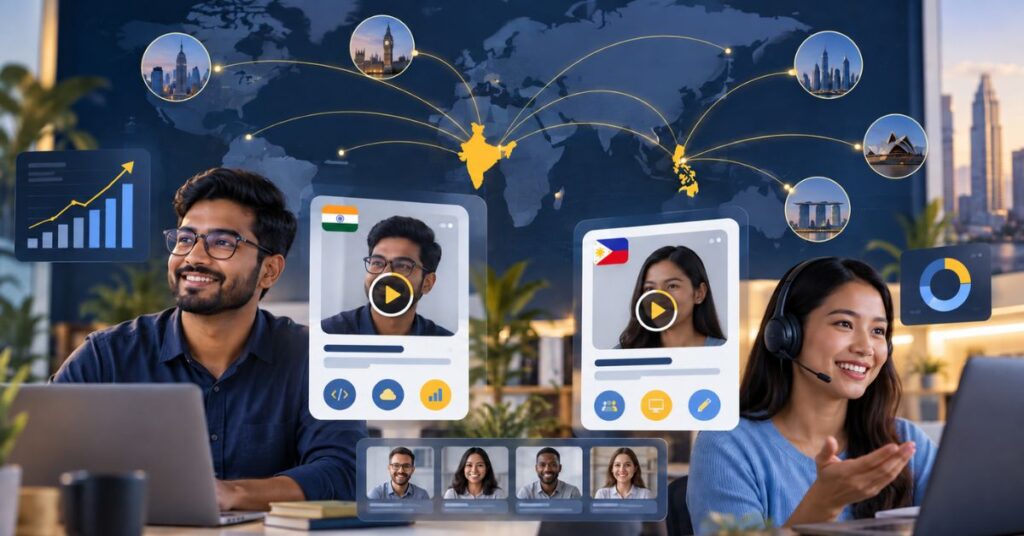
Remote Recruit helps employers improve hiring precision by combining AI Candidate Screening with video-based hiring and structured remote recruitment workflows. For employers, the platform makes it easier to evaluate global candidates beyond traditional resumes. AI-driven screening helps identify candidates who match role requirements, while video profiles give employers a clearer view of communication skills, professionalism, and personality. This helps reduce hiring uncertainty and improves decision quality.
Remote Recruit also supports employers who need scalable hiring systems for global talent acquisition. Instead of relying on outdated text-based screening methods, hiring teams can use a more modern process that prioritizes clarity, authenticity, and fit. This is especially valuable for companies hiring remote employees, offshore talent, or distributed teams.
For job seekers, Remote Recruit provides a professional way to stand out in competitive remote hiring markets. Candidates can showcase their skills, communication ability, and motivation through video profiles. This helps them go beyond static resumes and present themselves more effectively to global employers. By connecting employers and job seekers through AI screening and video-based evaluation, Remote Recruit creates a smarter, fairer, and more trusted remote hiring experience.
Conclusion
AI Candidate Screening is improving hiring precision by helping employers evaluate remote candidates more consistently, efficiently, and intelligently. As remote hiring grows, companies need tools that can manage larger candidate pools, reduce bias, detect inconsistencies, and identify the skills that matter most for distributed work. Traditional resume screening alone is no longer enough to support accurate hiring decisions in a global talent market.
The real value of AI Candidate Screening is not just speed. It is the ability to bring structure and clarity into a process that can otherwise become subjective and overwhelming. When combined with human judgment and video-based evaluation, AI helps employers make better decisions while creating a stronger candidate experience.
Remote Recruit supports this modern approach by combining AI screening, video profiles, and structured hiring workflows built for global remote recruitment. Employers can identify stronger candidates faster, while job seekers gain a better way to present their value. In the future of remote hiring, precision will define success, and AI Candidate Screening will play a central role in achieving it.
Frequently Asked Questions
What is AI Candidate Screening?
AI Candidate Screening is the use of artificial intelligence to evaluate job applications, identify qualified candidates, and support more consistent hiring decisions.
How does AI Candidate Screening improve hiring precision?
AI Candidate Screening improves hiring precision by analyzing candidate data against role requirements, identifying stronger matches, and reducing reliance on manual resume review.
Is AI Candidate Screening useful for remote hiring?
Yes. AI Candidate Screening is especially useful for remote hiring because remote roles often attract large applicant volumes and require consistent evaluation across regions.
Can AI Candidate Screening reduce hiring bias?
AI Candidate Screening can help reduce bias when it is designed around clear, role-relevant criteria and used alongside human oversight.
Why should employers combine AI screening with video-based hiring?
Combining AI screening with video-based hiring gives employers both structured data and human insight. AI helps filter candidates efficiently, while video helps assess communication, authenticity, and confidence.
How does Remote Recruit use AI Candidate Screening?
Remote Recruit uses AI Candidate Screening alongside video profiles and structured hiring workflows to help employers identify stronger remote candidates and improve hiring outcomes.
Sign up on Remote Recruit today to improve hiring precision with AI Candidate Screening and build stronger remote teams with confidence.